Let’s learn and create together!
Book your place
Please enter email and password to continue
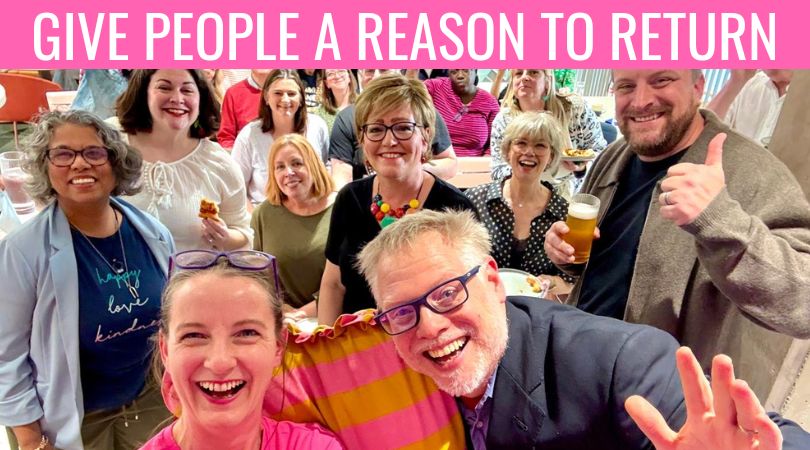
If people don’t come back, none of this lasts.
Retention isn’t a metric, it’s the proof that the space deserves to exist next month.
The success of any community isn’t driven by how many people you can keep coming through the doors. It’s driven by who stays, who returns and what that repeat behaviour does for everyone else.
For a long time, I thought the answer was to keep going with ‘more.’ More posts, more events, more ways to be visible. More output is what keeps people engaged.
Now I know the real lever is for people to stay.
Staying doesn’t come from doing more. It comes from designing a space that gets better the longer someone is part of it.
One of the ways I’ve learned to increase retention is by leaning into identity, our misfit mantra, so people can step away or come closer.
That’s different from simply delivering an event or a product aimed at “business owners.” Identity is a filter.
When someone recognises “this fits my way of working and my way of being,” staying becomes natural. People are not just attending something, they’re associating with something.
Retention is top of mind right now because we’re about to head into a full year of events and launching Lunch Club in Bristol.
I used to think the job was to make each new event feel different, that way it stood apart from other options. Now, the job is simpler, and harder, it’s building something people want to come back to.
That’s where the economics of community become apparent. When the business grows with help from the community, everyone benefits: the community wins, the business wins, the ecosystem wins.
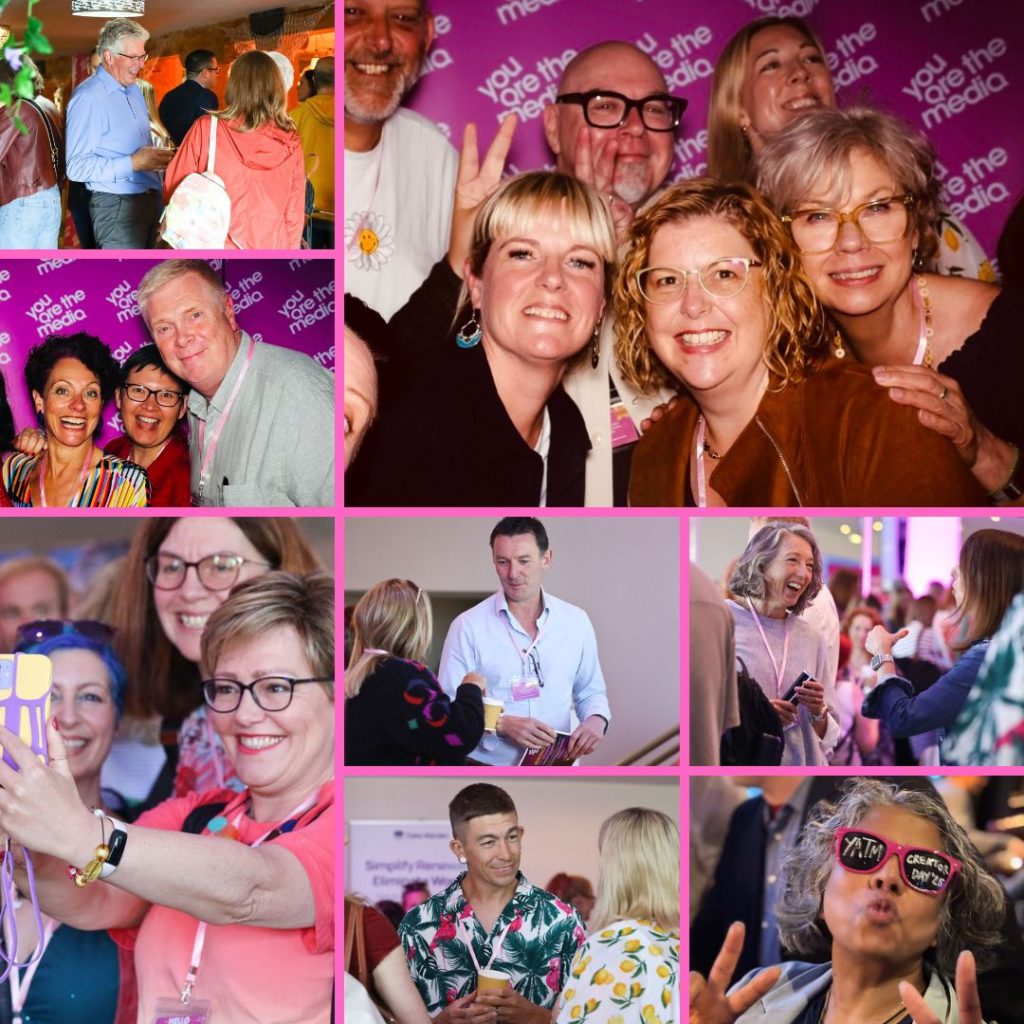
In every strong community, there are people who make it easier for other people to belong.
Christophe Stourton calls them anchors, the familiar faces who stabilise the room. They’re the people who welcome, include, and introduce without being asked. They create grounding for people where it may feel new.
Anchors matter even more when you run events in multiple locations and there is frequency. When the rituals and tone are carried by people, not just the organiser, you get cohesion. People arrive in a new location and still feel like they’re stepping into a room that feels linked. The community teaches itself, “This is how we do it.”
This is the retention benefit many people overlook, repeat attendance reduces social risk. When familiar faces are present, newcomers relax faster. Participation rises and connection forms sooner. This means the likelihood of returning happens.
I’ve learned that retention relies on stewardship. It can’t be held by one person, but becomes shared responsibility.
There’s safety in numbers. I’ve seen what happens when people are invested, they create value for each other that no organiser could do on their own.
In the build up to Creator Day ’25, people from the local area helped those who were travelling down with recommendations, via a WhatsApp Group. Where to walk, where to eat, the best fish and chips, what to do nearby. It created a collective spirit, people looking out for each other, before the event even began.
That’s a different experience from arriving isolated, where your only relationship is with an organiser and a schedule. Many of the people who travelled for Creator Day ’25 are coming back for Creator Day ’26, this May. That’s retention built through shared experience, not marketing.
Here’s the loop I’ve watched happen over the years:
1) Familiar faces lower social risk
2) Lower social risk increases participation
3) Participation increases belonging
4) Belonging increases return
Churn often happens when the experience doesn’t match what was promised. Even worse, when the space someone steps into is unclear.
You see it in events where it’s always new faces every time, so no continuity. You see it in online spaces that feel like revolving doors of input, where nothing settles.
Churn can look like rejection, but it’s simpler than that, confusion, friction, or just feeling slightly disappointment.
I’ve had to be explicit about what Lunch Club is and isn’t.
If someone comes to Lunch Club expecting to meet as many people as possible and talk about their business, they’ll leave disappointed. There are better places for that. Lunch Club isn’t a room for peacocking, it’s a room for friendship, people on each other’s side, where learning happens because you feel safe enough to contribute.
That’s why we lean into themes people can relate to, rather than a hierarchy where one person talks and everyone else sits quietly. The design is about participation, not performance.
Retention isn’t persuasion, it’s removing the reasons not to come back.
Most reasons are personal, uncertainty, friction and the feeling of “I don’t know what I’m walking into.”
It’s about doing the basics well. Eventbrite reminders and calendar invites are table stakes. Retention is built in the touchpoints around that.
This is what I do in the build-up to a Lunch Club event:
1) A week before, I send a “it’s on the horizon” email and what to expect
2) Two days before the event, I send the agenda and what’s going to happen
3) After the event: a thank you email, what’s next, and a clear next step
The point of this is that retention work happens long before the occasion starts and ends.
The mistake many people make is putting effort in only when it’s expected or only when it’s already too late.
Over the years I have learned that the experience becomes more valuable the longer someone stays. When you come and go, you don’t build friendships and other people don’t get the chance to build them with you. You miss the compounding, the feeling of being known, the ease of re-entry, the ability to contribute without self-consciousness.
Retention isn’t just “people returning.” It’s the community becoming easier to belong to because people start to know one another.
A Practical Model For You To Use
This is what it takes for people to stay.
Friction removed means clarity, someone knows what they’re stepping into. It’s expectations, onboarding, responsiveness, and “we’ve thought about you arriving.”
Value that grows means the experience gets better with time, familiarity, identity, anchors, shared rituals, and the ecosystem strengthening because people feel invested in the whole effort.
From my own experience removing friction is when people know you are there for them.
For instance, someone thinking about joining YATM Club may not understand how it works, or looks. So onboarding has to start before they join, helping them picture themselves inside it, and making the first steps feel safe and obvious.
Value grows when people feel part of the whole, not when they are treated as passive consumers. That’s why Creator Day evolves in small tweaks each year, not change for novelty’s sake, but change that reflects what people are actually responding to, so the whole effort stays connected to the people inside it.
Here’s a practical checklist I work from:
✊ Make it easy to book and commit (remove decision friction)
✊ Answer the awkward questions before anyone has to ask
✊ Find and support anchors (they welcome, include, introduce)
✊ Make the second call-to-action close to the first (design for return)
✊ Create progression (newcomer → regular → anchor)
✊ Keep expectations and experience aligned to people
The goal isn’t to look to a bigger crowd.
It’s to build a room people feel safe enough to return to.
Retention is the proof the space is working, because it turns a one-off moment into a place that gets stronger every time someone comes back.
A brand new programme from Mark Masters for businesses wanting to make that next growth step.
Find out moreShape more together