Let’s learn and create together!
Book your place
Please enter email and password to continue

Repetition helps people recognise the pattern, responsibility is what turns it into something people can lean on.
AI can help us produce almost anything. It can polish, package and speed up our output, but none of that guarantees we matter to someone else.
Being visible and continually showing up isn’t the same as being part of someone’s life.
Relationships are built when people have something they can come back to. It is a place where they don’t have to always start from zero. That’s what routines and rituals do. They create familiarity, then trust, then closeness. Not through intensity but through something more underrated, reliability with other people in it.
That’s the gap AI can’t fill. It can help us publish, but it can’t replace what happens when someone knows, “You’ll be there. I’ll be there. This is ours.”
Every Thursday, I post a message in our Sea Dip WhatsApp group. It says, “Who’s in for tomorrow, see you at the beach hut 7.30am?”
It’s not pushing anything, it’s just a small signal that creates a promise. I’m going to be at the beach hut, and if you want to join, you can.
We’ve done this for four years. It’s a simple way for people to show their hands and say, “I’m in.” That moment matters because it’s not about individual willpower, it’s our weekly agreement.
Then Friday arrives, at the moment, it’s cold. It would be easy to say, “I’ll do it next week,” but people don’t disappear and they turn up. I now recognise the shared act changes everything. When you walk into the sea with others, you feel braver and less alone.
This is what we underestimate. Responsibility to show up isn’t pressure, it’s contribution. For a sea dip, turning up is the value. If I arrived alone every Friday, the ritual would fade. Not because the sea isn’t there, but because the closeness isn’t.
The contribution is presence and being present matters so much today.
We have more ways than ever to be visible, and yet a lot of people feel oddly unseen.
You can post something on LinkedIn that gets a burst of attention, and within days it’s buried under the next wave. The real temptation isn’t just ‘getting seen.’ It’s the urge to go back and try again, to chase the hit, to see if lightning strikes twice.
In most cases, it doesn’t….
This is my ‘slot machine’ feeling.
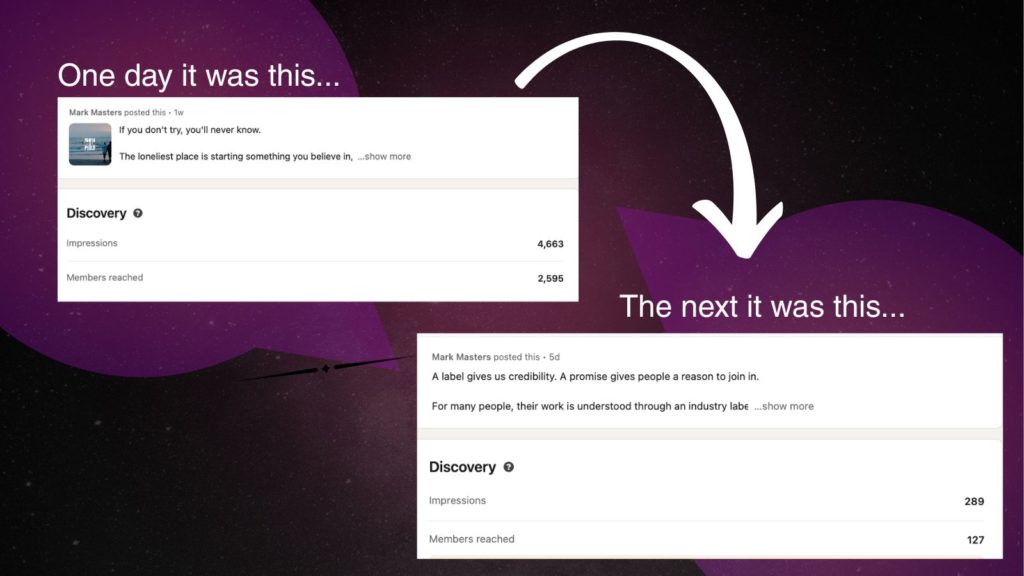
Being visible doesn’t automatically lead to closeness. You can be recognised online and still feel detached in real life. Being known by people is not the same as being counted on by people.
Here is the distinction:
Repetition on its own is consistency.
Responsibility is what turns repetition into a ritual.
I could decide to go for a sea dip every Friday morning on my own, that’s consistency. A ritual begins when your presence affects other people and their presence affects everyone else.
Consistency is something you do, a ritual is something people share.
Machines can make more and more output without us. That means content isn’t becoming scarce, but closeness is. How can you be part of someone’s week that feels genuine?
Here’s the simplest way I can explain it:
Belonging = repetition × responsibility
Repetition is the rhythm people come back to and the ‘it’s there for me’ feeling.
Responsibility is the moment someone steps forward and becomes part of what makes it work.
From my own sea dip experience. If repetition is the invitation (“Who’s in tomorrow?”) responsibility is the RSVP, when someone else says “I’m in.”
Let me bring this into a few real-life examples from YATM.
Work Together has become a focus ritual. Twice a week, at 9.15am, there’s a place to turn up and get on with your own work, but with other people alongside you.
It’s not a workshop, it’s simply: “I’m here, doing my thing, and you’re here too.”
When you know others are working at the same time, you settle in and stop drifting. The live room is what holds you to it.
Responsibility looks like:
☀️ Making the decision to show up
☀️ Saying before we start, “This is what I’m working on”
☀️ Staying for the full window, so the rhythm stays dependable
People don’t just come for output, they come for the feeling of not having to do it all alone.
Every Lunch Club starts with food at every location. It’s how we’ve always done it.
Food flattens status and a stubborn signal that says, ‘we’re doing this together.’ Eating together turns an “event” into something more down to earth. It lowers the awkwardness for people where this may be new and helps everyone arrive as themselves.
Responsibility looks like:
☀️ Sitting next to someone you don’t know
☀️ Starting an easy conversation, not a networking pitch
☀️ Not letting people hover at the edge
You don’t need to be the host to contribute, you just need to be someone who helps the room feel settled.
We do something that makes no sense to most of the business world. We try to break a world records at a work event.
It’s a play ritual where we give people permission to let their guard down and just join in. It’s so people know they are in a space where we’re encouraged to bring more of ourselves to the table and the ‘professional persona’ outside.
A room becomes warmer when people participate in something slightly ridiculous together.
Responsibility looks like:
☀️ Having a go, even if it feels silly
☀️ Making the people at the front feel supported
☀️ Everyone else cheering, joining, clapping, laughing
Creator Day is our belonging ritual. It’s one place, for a moment in time, where people show up to be part of something bigger than their own work.
It’s the togetherness that matters, not the talks. People add to the atmosphere that makes connection possible.
Responsibility looks like:
☀️ Attending with intent to join, not just consume
☀️ Being open to sitting with new people
☀️ Treating the day like a special occasion, not a transaction with how many LinkedIn QR codes to scan
Nobody wants to lead an idea that becomes “another thing” people forget.
A ritual becomes powerful because it’s dependable and over time, it becomes what people return to.
This is what I’ve learned building YATM, and it applies to your work too, rituals don’t scale through producing more content. They scale through participation.
A ritual works when:
🏡 It’s predictable: a set day/time people can rely on
🏡 It’s social: it only works because others are in it too
🏡 It has roles: people can contribute in small ways
🏡 It’s low pressure: joining doesn’t require proving anything
🏡 It creates continuity: each time makes the next time easier
Building stronger relationships doesn’t start with “How do I get noticed?”
It’s about playing a small part in someone else’s week or month and giving people something they can come back to.
It’s the repetition that becomes the rhythm and when the responsibility is accepted by others, it all becomes real.
Keep to the day you send the newsletter. Hold the mainstay in your work. Show up on a Friday when you said you would. Treat the moments you create as places people can return to.
That’s how people become familiar. And familiarity, done with care, is how closeness starts.
A brand new programme from Mark Masters for businesses wanting to make that next growth step.
Find out moreShape more together