Let’s learn and create together!
Book your place
Please enter email and password to continue
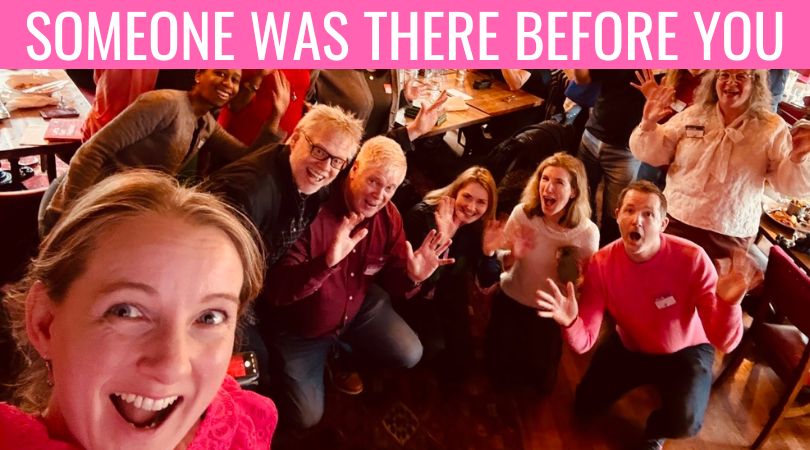
They only become meaningful when people keep turning up.
People arrive at different points, but there will always be someone who was there before you.
When you feel part of a space, most of the value doesn’t come from what’s happening today. It’s in what’s been built up over time.
Community isn’t a small group that turns into a crowd. It’s a chain that forms over time.
I’m giving full credit here to a reference and conversation with Felicity Hopkinson and Rachel Extance who teed up this idea.
A space has history whether you acknowledge it or not. As people join in, they’re stepping into something that already has a shape because someone else has been there first.
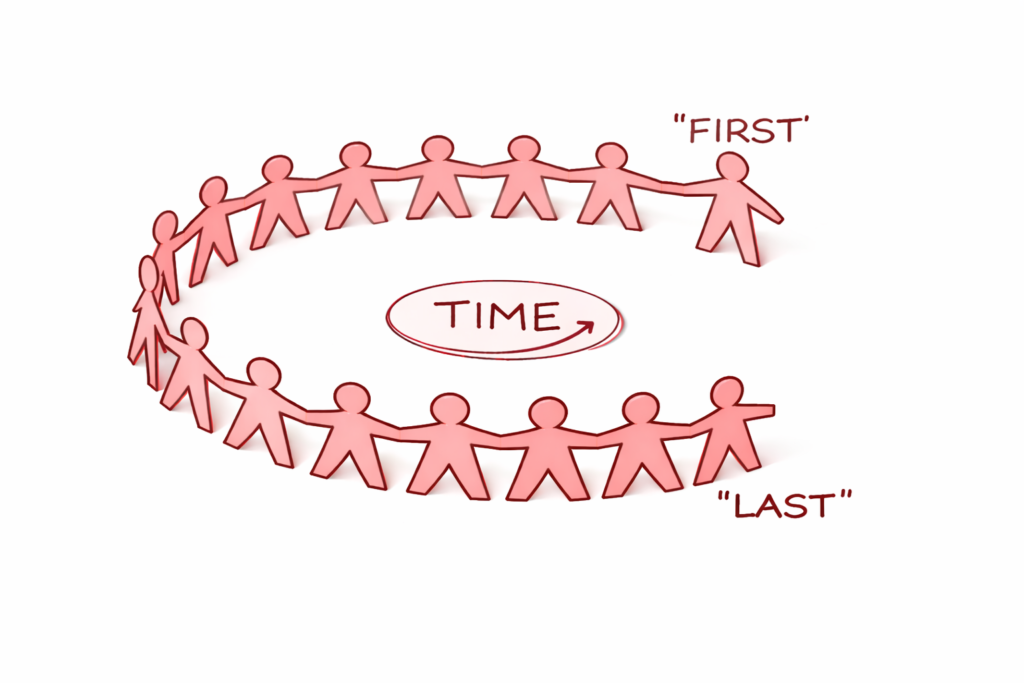
In healthy communities, being ‘earlier’ isn’t status. The people who’ve been around longer aren’t ‘better,’ they’ve just had more time in the room. They know what matters and make the space easier to enter.
That’s why ‘someone who was there before you’ matters. They remove friction without needing credit for it and they help a space feel like it has shape.
The longer the space exists, the more work has already been done to make it hold.
That’s why time matters. Anyone who comes to a Lunch Club is stepping into a chain that started in 2016. Anyone who subscribes to the YATM newsletter is stepping into one that started in 2013.
There’s been a decade of small adjustments, learning, and care that makes it easier for someone new to join.
Turning up somewhere new can be an experience you endure alone, or it can be something you share.
No one wants to feel like they’ve arrived halfway through the film. It is good to have your bearings that the moment you step in, it shouldn’t feel new, it’s ready for you.
You move from feeling like an outsider to thinking, ‘I can be part of this.’
It isn’t about a grand welcome. The small gestures matter:
– someone recognising you at the door
– someone introducing you without making it awkward
– someone telling you “this is what happens”
I’m seeing this happen with Lunch Club London, so I can share the proof rather than just the theory.
When we started YATM London last year, there was a convoy from Poole heading up together.
It was new and it felt exciting. There was novelty in taking a format we’d grown in Poole and seeing if it could take root somewhere else. The deeper reason the convoy mattered is that it carried the culture into a new room.
It meant that when we arrived, the space wasn’t starting brand new. The room already had people who knew the intention.
It’s easy for a first event to feel like a trial and waiting for other people to decide it’s “worth it.”
The Poole convoy helped to set the scene, by just being present. It made conversations easier because there was already a shared reference point in the space to say ‘hello.’
We went up last week for the February Lunch Club event and the convoy on the train was much smaller.
What it demonstrated is that London is finding its feet. It’s growing into something that belongs to the people where the London events are more accessible and can step into it naturally. The room is starting to hold itself.
Which means the ‘before you’ people are now in London.
People are now becoming part of our London ‘scene’ and make it easier for people who are attending for their first time.
A community is a chain of people making it easier for the next person to join in.
If you keep going, and you let the space learn, time starts to do things you can’t manufacture with tactics.
1) Time creates shared reference points.
People build small memories together. It could be “last time,” “remember when,” “you should have seen it.” Shared reference points are social glue, as they make people feel like they’re inside something, not just attending.
2) Time creates reliability.
People know what the room represents, so they don’t have to perform. When people stop performing, the quality of connection goes up.
3) Time creates stewardship.
The longer a space exists, the more it produces anchors, people who care about the feel of it. They protect the tone without needing authority.
4) Time creates a softer landing for newcomers.
This is because the room has learned how to welcome. There are already faces who will notice you and a sense that you won’t be left on your own. People still have to decide it’s for them, but they don’t have to fight the room to find out.
This is how communities become more than gatherings because the chain gets stronger.
The ‘before you’ effect isn’t only about place, it’s also generational.
We see this with the Creator Lab programme with Bournemouth & Poole College. It’s a six-month programme with apprentices, built around confidence, belonging, visibility, and practical progression. It’s helping young adults feel part of something wider than their classroom, and to get closer to what’s possible after education.
Ben Egginton was in the first cohort in 2022, at 18.
Last week, now 22, Ben came into a session and shared what the early part of a career looks like after college. Namely what’s been challenging and the opportunities that have been presented.
Ben represented a link in the chain. He once sat where the current students sit. He knows what it feels like to start a career and can say ‘this is what it’s like’ with credibility.
Earlier links reduce the risk for new people stepping in.
It tells the current cohort that there is a route, where someone has walked it.

Time served on its own doesn’t mean much.
Longevity is when the room keeps getting ready for people who haven’t arrived yet.
It’s when the culture is carried by the chain, not by one person.
It’s not reliant on the founder’s efforts, a big guest, or the same handful doing all the work. Over time, the community teaches itself how to welcome and how to make it safe for new people to come in and find their place.
A community has meaning when you make it easier for the person who turns up after you.
That’s how a chain grows, quietly, but effectively, over time.
Someone was there before you. The best communities teach you how to become that person for someone else.
A brand new programme from Mark Masters for businesses wanting to make that next growth step.
Find out moreShape more together