Let’s learn and create together!
Book your place
Please enter email and password to continue
An initiative works when participation is clear. That means people know how to be when they arrive.
A question that used to frustrate me, that I’ve had to figure out, is when someone says, “The reason I don’t join in with YATM is that everyone looks like they are having fun on the inside.”
For a long time, my only answer was, “You have to step in and see for yourself.” But that puts the pressure on them.
What I’ve come to understand is that people arrive at different points. You have to allow for that.
You don’t design community. You make the next step obvious.
There’s a tendency to think of community as something you create. You put everything together and then wait for people to get to know each other. It could be events, or it could be a platform.
From the outside, none of this tells someone how to take part. You bring people into the space and they’re unsure what to do. Even worse, they stand to the side.
Community isn’t the activity you build, it works when people know how to step in.
Which means community design is really participation design.
There is an idea that community is what it looks like at its peak. People coming together and conversations flowing. We see it in videos and pics of what the live version looks like.
What is missed is how people arrive. When you step into a space for the first time, it’s often quiet, with apprehension and no knowing. In the case of Beth Carter, it took her three attempts. “The first two YATM lunches I booked, I cancelled on the day. On the third attempt, I walked through the door. What I found is the most welcoming space I’ve encountered in networking. Nobody is calculating whether you’re worth their time.”
What Beth shows is if you design for the fully engaged version of someone, you miss the version that turns up first. That’s the version that matters.
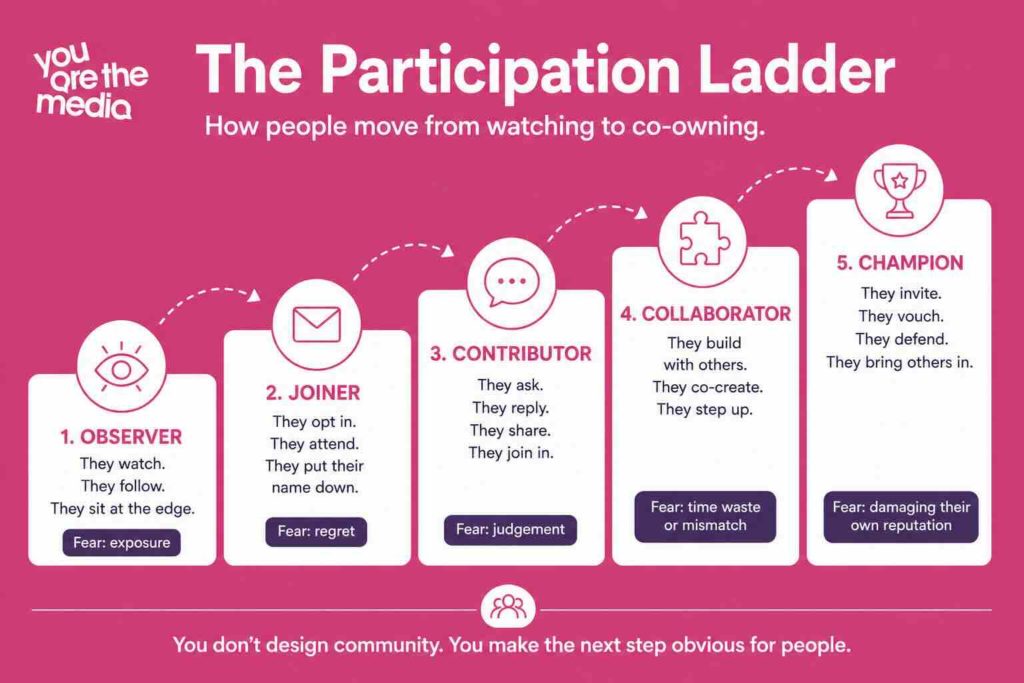
Not everyone arrives ready to contribute and not everyone wants to lead, but everyone can take a next step.
That’s how it works. This is how I have seen it shape over the years.
This is the person who sees what is happening and more often than not, stays on the edges.
For a long time, this has been the stage that has frustrated me the most. It’s the bystander who never steps forward. Sometimes, if I have reached out, I now realise that puts added pressure on them. That gives the result of keeping observers where they are.
The reasons are usually simpler than we tell ourselves. It could be the fear of feeling out of place or stepping in and saying the wrong thing.
Your role isn’t to pull someone in, it’s to make it feel safe enough that stepping forward becomes possible.
This stage is the biggest hurdle and what can make or break your efforts because the moment someone feels like they should already know how it all works, they leave.
This is the first visible step. It is when someone subscribes or they sign up, or attend.
These are the people who join in with our Lunch Club events. It’s where someone has moved from the outside to the insider.
This is where you are going to see the biggest drop off. People don’t announce they’re leaving, they just fade away.
Joining doesn’t remove uncertainty, it increases it. It’s your job to reduce that feeling as quickly as possible. For instance, when someone subscribes to the weekly newsletter, they receive a short ‘hello’ email from me. It asks a couple of questions, so we take it from the automated side to the personal side.
The less someone has to figure out, the more likely they are to stay.
This is where you start to see a shift. Someone replies to an email, comments on a post or joins in.
It might not seem like much, but this is a big step in someone knowing they can take part. To reduce the friction, subscribers to the YATM newsletter are invited, if they’d like to start the newsletter, so people can connect with them.
Contribution comes with risk. Not of being wrong but of being ignored. It’s your job to make everything feel settled and part of the structure to what you do. That means responding and acknowledging other people’s contributions. It matters to let others know they feel seen.
When contribution is received, not ignored, it becomes easier for the next person to step forward.
This is where belonging begins to show.
This is where people start to build with you and others. For YATM these are the people who host or step up to the front to be part of the panels.
A collaborator is a person who is willing to step forward.
This is where the community becomes visible beyond you. On a personal level, this is where someone progresses from ‘this is something I’m part of’ to ‘this is something I help shape.’
People don’t invest time in something that isn’t partly theirs. The biggest risk is that someone feels they have wasted time by stepping up and collaborating. Their time and focus have to be worth it and it has to lead to something. This could mean confidence or being connected to more people.
You have to give people a way to say yes without overcommitting. Once people experience a positive collaboration, they’re far more likely to do it again.
This is the stage of advocacy. This is when people are prepared to fly that flag for you.
It is an amazing feeling when they invite others and are prepared to defend it when it matters.
The greatest sense of fulfilment this provides you is when growth happens without you pushing it. This also provides the highest risk for someone else. No one wants to say ‘come to this’ only for someone else to leave disappointed. This means your ally has a reputation attached, so you have to work harder to make sure it lives up to every expectation.
People don’t promote something just because it’s good. They promote it when it feels safe to stand alongside. Your job is to give people something worth sharing.
People are more willing to be vocal when they recognise the moments that matter to them. When they see this, they’re far more likely to bring someone else with them.
People need to see how they can take part. It is your responsibility to make the steps visible.
Asking ‘how do I build community’ is too big. You can break it down to something more manageable, that is, ‘what’s the next step that can make it easier?’ When the next step is clear, people take it.
Community grows when participation feels easy (but you’ve done the work behind the scenes). If people know how to take part, they will. If they don’t, they won’t.
Everything else is just noise.
A brand new programme from Mark Masters for businesses wanting to make that next growth step.
Find out moreShape more together