Let’s learn and create together!
Book your place
Please enter email and password to continue
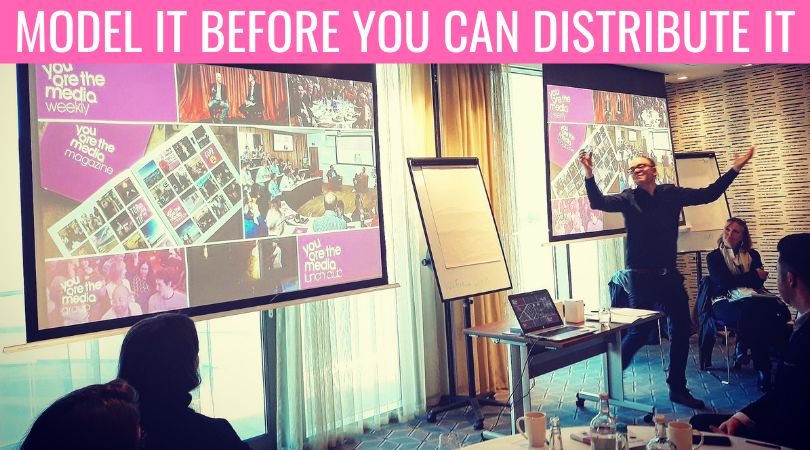
You have to do so much work at the start, where it can feel unrewarding before other people can carry it with you. This is something that not many people talk about because we like to create the impression that community somehow carries itself.
Nobody wants to put their hand up and say, “I’m doing nearly everything.” That is often where it all starts.
This article was inspired by a post from Jessica Lackey, it’s here. The message from Jessica was you can’t wait for people to discover you, you have to go towards them.
Today YATM is a learning community for small businesses who are creating something of their own.
We have people leading sessions at in-person events around the country and inside our online space, YATM Club. It feels like a place where people are active and feel part of something. For many, it has become a third space.
Contrast this with where it all started, everything was on me.
If I wanted people to read something or understand what I was trying to build, I had to write it. If I wanted people to meet, I had to create the reason, talk about it and personally invite people.
There wasn’t someone telling another person that Lunch Club was worth trying. There was no momentum waiting for me. I had to create it. When you start something, you have to model what you want before other people begin to understand that it is for them too.
Community can be made to sound wonderfully organic, but it just doesn’t start that way.
Perhaps eventually word of mouth grows, people gather and it starts to find momentum, it just takes a lot of work to get there.
I still do a lot of the work today. When someone subscribes to the YATM newsletter, I’ll try and find them on LinkedIn and connect. It’s a small way of letting them know that I see them.
When Lunch Clubs are on the horizon, I have a database of all our events and I’ll reach out to people inviting them to attend. I’ll send emails and DMs where people can tell it is an invitation from me rather than an automated send.
If someone is considering joining YATM Club, I have a page where they can book a 30 minute call with me. I could record a video explaining the Club once and send every interested person the same link, I don’t. I want people to know they can have a conversation with me and understand whether YATM can play a useful role for them.
Then there is the YATM newsletter. I put time aside every week to write about what feels current around community, interdependence and a “more together” approach to our work.
If I am being honest none of what I shared scales particularly well. However, I know the effects do.
When we automate too much of our work, it can feel less personal. When people can see that you have taken the time to notice them, invite them or speak with them, that effort is recognised.
I’ve learned that many personal actions do not scale, but behaviour can. It’s the invitation you make that becomes the work. Whereas outreach is part of the work, to encourage people to make a commitment to you.
Anyone who wants to start something around an idea has to accept that they will probably care more about it than everybody else.
You may have lived with an idea for years. You have the history, context, relationships and emotional investment. Someone who recently subscribed or connected with you doesn’t.
That is why founders can be easily frustrated when other people don’t show the same level of commitment. It’s never nice when you reach out to someone and you don’t get a reply. That’s just the game we play. We can mistake our own attachment for a reasonable expectation of someone else.
You cannot demand an emotional shortcut. Attachment has to accumulate over time.
People need to see what you are working on, what you are thinking about and the body of work you have created. They need experiences with other people. They need repeated evidence that what you are making is worth investing a little more of themselves in.
The founder has to invest today in behaviours that may only become visible years later.
This means carrying more than your fair share of the work at the beginning.
With all this work on your shoulders, the purpose isn’t simply to grow attendance or encourage more people to buy in.
You are showing people how your space behaves and what kind of culture you are trying to shape.
When you personally welcome someone, you’re showing that courtesy matters. When you introduce people to each other, they know that connection is part of the culture. When you invite someone rather than waiting for them to notice, you show that people matter enough to be asked.
Slowly and over time, people understand. The early work you do is partly cultural instruction. It’s your way of building the foundations to say, ‘this is what we do here.’
There is another side to this. If everything is just from you, you model dependency. If every decision comes through you, people learn to wait. If you are always the speaker, people learn to watch. At first, the community needs you to do disproportionately more. Eventually, it needs you to resist doing things other people could begin doing themselves.
The same behaviour that helps establish a community can eventually prevent it from developing. At some point, good leadership changes from always doing to deliberately making room for other people to step up.
What I am sharing here is based on my own observations of what happens when other people gradually begin to carry the initiative you started.
For instance, people lead Lunch Clubs, recommend Lunch Club to other people and when our events happen a lot of the activity in our WhatsApp Groups is driven by other people, not just me. These might look like small acts, but it shows that participation is when someone joins what you have created. A new threshold is crossed when someone decides to make something happen from their own volition and what happens next.
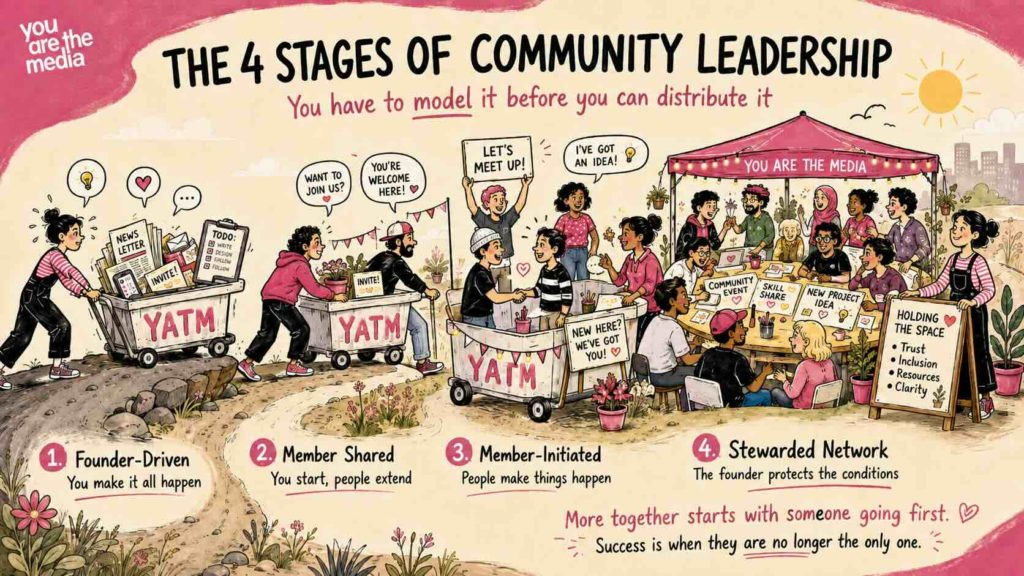
There are four stages I am seeing when it comes to community leadership. What happens is over time, what you carry becomes shared with others.
Founder Driven – You Make It All Happen
This is where the majority of the energy originates from the founder.
You create all the content, the occasions, the introductions and invitations to keep the idea seen.
The problem is if you stop, the activity will stop too. Most communities start in this place.
Member Shared – You start, people extend
The founder is still a significant source of momentum, but other people begin carrying aspects of the community further. This could be contributing to conversations, welcoming others and build relationships that no longer require the founder to sit in the middle.
As an example, this is where much of YATM sits today.
Member Initiated – People Make Things Happen
This is the pivotal stage. People start taking responsibility without waiting for the founder.
These are the people who can help start and move forward. For instance, it could be introducing other members to each other, or helping to answer a question that isn’t just from the founder. It could also be supporting a newcomer at an event or offering to lead.
Lots of attendance, enthusiasm and conversation do not automatically mean ownership has transferred.
We are seeing the gradual progression of YATM into this space. It’s about what exists that you didn’t create. The strength in this place is when positive action happens without waiting for you.
Stewarded Network – The founder protects the conditions
This is where the founder doesn’t disappear, but the role changes. Instead of producing most of the momentum, you increasingly protect the conditions in which other people can create momentum.
It means you protect and take care of the culture, you can see where trends are happening, you connect people, provide direction and step forward when needed and step aside when someone else can.
It’s not about stepping aside but reproducing the behaviours without you always at the helm. This is where the network becomes capable of creating its own momentum.
The ultimate achievement of community leadership isn’t getting people to follow you. It’s helping people discover what they can do with each other. This is the place I eventually want YATM to reach.
At first, the effort is largely one-sided. You do the work, make the invitation and create the progress. It isn’t about a loss of control but proof that the earlier work mattered and led to something far bigger than you started.
You have to be comfortable doing a lot of work before that happens. The long-term achievement is creating a place where more people feel confident enough to do the work too. That’s a hopeful place to be.
More together starts with someone going first. Success is when they are no longer the only one.
A brand new programme from Mark Masters for businesses wanting to make that next growth step.
Find out moreShape more together