Let’s learn and create together!
Book your place
Please enter email and password to continue
Trust and belief are built faster when you’re not practising in public alone.
Have you noticed how the “big names” seem to know each other? The same people comment on each other’s posts. See it once, you see it everywhere. It’s the same guests that do the rounds on podcasts. The same work gets shared by the same few, over and over again.
To the rest of us, it can look like there’s a hidden rulebook. Spaces reserved for people who already have credibility, reach, and a head start.
What it shows is that we trust what’s already trusted.
When there’s a lot around us, we lean on shortcuts. We use signals to decide what to pay attention to and who to believe.
That’s why recommendations work and introductions matter. Being associated with someone else can change how people read your work before they’ve even considered it properly.
This is what it can look like:
– someone vouching for you when you’re not in the room
– someone sharing your work with context, not just a link
– someone saying, “I’d trust this person”
– someone putting your name forward for a panel, a project, a client, a collaboration
If someone already trusts you, you don’t have to prove yourself from scratch and perhaps your next opportunity arrives faster? If someone already backs you publicly, other people relax around you.
Follower counts still act as an eyeball test for legitimacy. Not always, but often. It can feel unfair, especially early on, when you’re doing good work but you don’t yet have the signals that make strangers lean in.
Here’s the shift I’m making in how I think about it.
Small circles beat big audiences at the start.
Not because you’re trying to engineer attention, but because you’re trying to build belief, in yourself, in your voice, and in the fact that what you’re making is worth continuing with.
Belief is the first thing to disappear when you’re building in public.
It’s hard to keep putting your ideas out there when you feel like you’re speaking into a vacuum and when you don’t know whether anyone is there on the other side.
That’s why small circles matter. They don’t just help your work travel, but they help you keep going.
We have the Creator Lab programme up and running with Bournemouth & Poole College. This is with apprentices who are just starting out in their careers and between 18 to 20 years of age. One of our tasks is to share the values they live by (when you don’t have years of experience under your belt, you still have principles).
Once everyone has done the task, each person shares their own story on LinkedIn. Rather than posting and walking away and the risk of feeling awkward if no one engages, the team share their URLs with each other and they back each other up with acknowledgment.
Have a look at the work, to see what I mean (maybe you’d like to join in too). Here is Dexter Dickinson and his value, read here. Zhanna Ahmed moved over to the UK from Ukraine, three years ago and this is what Zhanna stands for, read here.
Instead of that feeling of “I’ve posted… now what?” the silence, the second-guessing, the mild embarrassment if nothing happens, the college team experienced the fact that someone noticed. It makes the next piece of work less daunting and even safer.
For the record, this isn’t about encouraging a pod.
I want to make that distinction as it matters. A pod is performative engagement designed to game a system. A circle is deliberate support designed to reduce isolation, increase practice, and build belief.
This isn’t about manipulating reach. It’s about making it less lonely to practise in public. That’s a completely different motivation.
When you’re new (or when you’re rebuilding), so much of the weight sits on your shoulders. You have to generate the ideas, create the work, press publish, face the reaction, and then do it again. It’s not just workload, but an emotional load too.
A small group of people who recognise your work, respond to it, and nudge you forward is what makes it easier to keep going.
When people know others are there for them, they are more willing to make that next step.
People publish sooner and stop polishing the life out of everything. They learn faster because they publish, receive feedback, and refine in motion.
I see a version of this inside YATM Club through our Sense Check sessions. It is centred around people sharing what they haven’t quite brought to life yet, but would like input and thoughts around what they’d like to progress. The intention is to help people make modifications, stop what they are doing, or just encouragement to progress.
Two things tend to happen when a circle works.
First, people get clearer. Not because someone gives them ‘the answer,’ but because being witnessed and questioned properly brings the shape out of the fog. When you’re thinking in your own head, everything sounds plausible. When you say it out loud to people who want you to win, reality becomes useful.
Second, people start to root for each other.
That’s the underrated part. The moment people feel supported, they stop behaving like they’re on their own. They become more generous, remember names, make introductions, show up and help the space improve.
Identity and relationships become more apparent.
It’s not the “rush hour” feeling of being lost on another platform, surrounded by noise and strangers. It’s the feeling of being part of something where people notice what you’re trying to do and want it to work.
Your best work doesn’t spread by itself. It travels through people.
The alternative to pandering to algorithms is building pockets of trust, spaces where people are there for the right reasons and prepared to stand beside you. It also saves time, money, and energy.
Broadcasting to strangers can be expensive (emotionally and financially). You end up chasing reach, second-guessing yourself, trying to “be consistent” in a way that feels hollow. Building with people who notice you is different.
It means your work and ideas start to travel, where it’s the people around you, who give you the propulsion, not the platform.
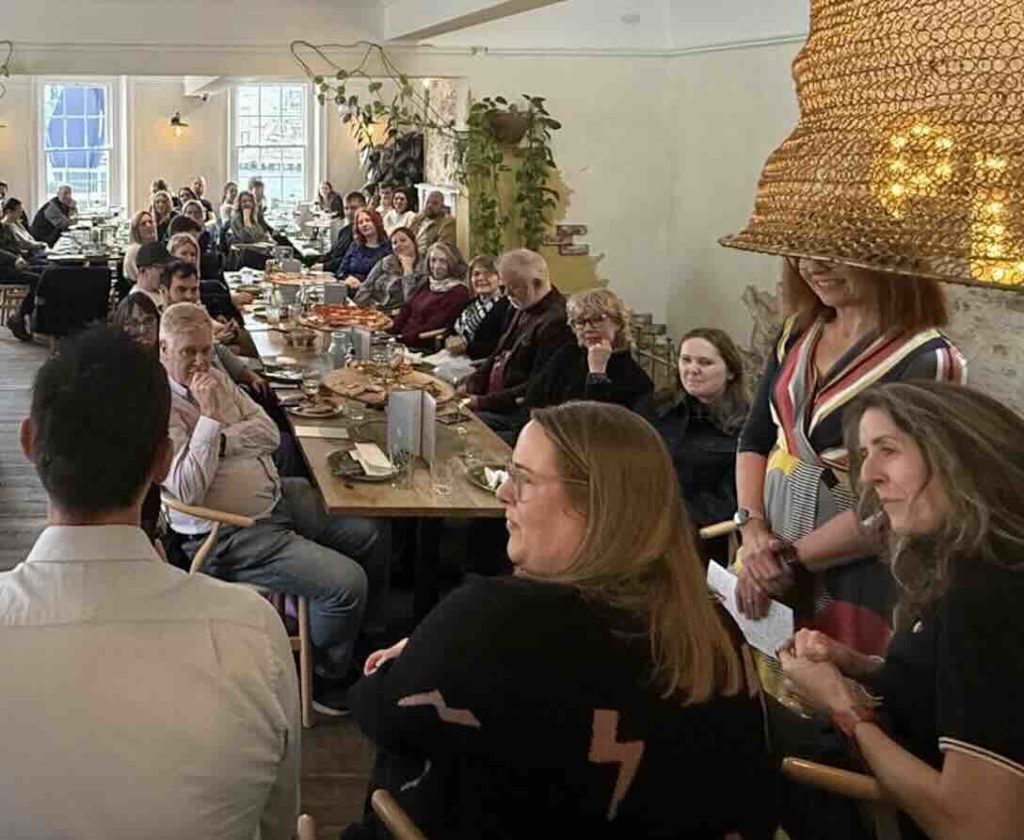
You can see this in small ways at our Lunch Clubs. After an event, when someone shares their thoughts and photos on LinkedIn, it’s usually the people who were in the room who join in first, to help reach.
It just feels easier when you’re part of a space where people are with you. Those spaces are findableand better still, they’re buildable.
Being part of a close, connected space isn’t about joining an elite club. It’s accelerating what you create by not carrying it alone.
I see it in Creator Lab with young adults learning to step up and be seen and then being amplified by people around them.
The real win early on isn’t attention. It’s repetition with support.
My ambition for Creator Lab and for every space built on encouragement, is to help people keep going long enough to become someone worth paying attention to.
You don’t have to keep chasing an audience.
Start by building a circle that makes you braver.
A brand new programme from Mark Masters for businesses wanting to make that next growth step.
Find out moreWhere non-conformist business owners come to work, learn and make friends. Click here