Let’s learn and create together!
Book your place
Please enter email and password to continue
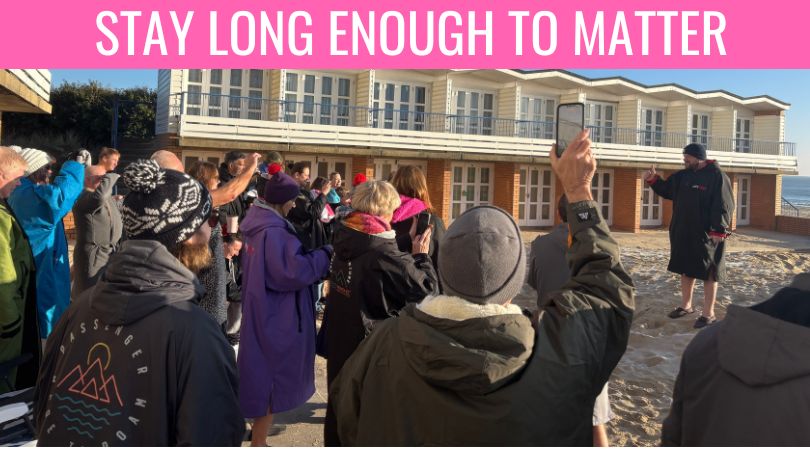
Starting something new doesn’t have to be fixed on the glory that you want to happen. It’s pulling away from the noise of outcome-chasing and back into the only thing you can control, what you do next, and what you do after that.
When you know you want to be in something for the long haul and take gradual steps, everything feels less intimidating. Not because you’ve lowered your ambition, but because you’ve matured your relationship with time.
The problem is, we’ve been trained to bring pressure far too early.
We step forward with an expectation of return. If it’s not revenue, it’s audience and acceptance. If it’s not audience, it’s reach. If it’s not reach, it’s ‘traction.’
The biggest mistake is treating the beginning like a pitch deck for something that already has proof.
The beginning doesn’t have proof. The beginning has potential, and a slightly wobbly first version. That’s the deal.
When you feel that pressure, you start to behave in ways that quietly sabotage what you’re trying to build. You avoid inviting people in until it ‘looks right.’ You wait for the return before you’ve earned it and you never give the routine a chance to do its job.
When I started You Are The Media, I didn’t take it seriously. It was something I could play with, experiment with, and see what happened if I showed up every Thursday with a newsletter and built subscribers.
My mindset had a cost.
Progress was slow and because of this I didn’t stand up proudly to talk about it. It was a work in progress and I was figuring it out. The difficult thing about a rough first version is that people can’t easily make an association with it, or see the role it might play for them. It didn’t fit into a category people already understand.
That’s why the early stage of building anything feels so personal. You’re not just being visible with your work, you’re asking people to make sense of you while you’re still making sense of yourself.
Peter Drucker said, “Strategy is a commodity, execution is an art.” It’s not just about having a good idea. It’s about persisting with it long enough for it to land with other people. The art is the consistency and staying with it as it takes shape.
Many of us start something while carrying a belief we’ve absorbed from somewhere else, that success should show up quickly. If it doesn’t, it’s a sign you’re not good enough or it’s not viable.
That belief turns early-stage work into something you feel embarrassed about. For me, because I didn’t recognise the role YATM could play, I continually under-sold it. I hid behind ‘just trying something,’ even though I cared about it deeply.
The results didn’t come quickly, and I read that as failure, but because it was all on me, I kept going. The first pound was made three years after YATM started. In the early days it wasn’t built with a business slant. It was built with presence in mind. I wanted to learn how to show up, how to write, how to connect, how to build an audience when not many people knew who I was.
But here’s what I didn’t understand then and I do now:
Slow is not the sign it isn’t working. Slow is often the sign it’s becoming genuine.
This video explains (thank to El Deane for recommending it).
The message from the video is that longevity is the advantage. You might discover you’re not the best early on, but you can still win by staying in it longer than most people do.
When you start, the audience you hope for probably won’t be there. You’re building familiarity, trust and a sense of “this person shows up.”
If you make “return” the barometer in the first phase, you create a setup where you’ll abandon the work right before it starts to matter. Which is also the part where your work is collecting its first proof points.
The beginning isn’t where you cash in. The beginning is where you find the signal. This could be someone who subscribes to your newsletter, someone replying to you, or a small group of people who start to recognise what you stand for.
If you want something practical to hold onto as the year begins, here are four prompts to keep you in motion.
1) Embrace the learning journey
You’re not just building a project. You’re building your capacity.
You start to learn and improve, not just your project, but you too. It’s all about putting in the time and effort into something new that can potentially open opportunity. For me, writing a weekly newsletter became a place to test ideas about community, visibility, and building your audience without relying on algorithms.
Goal: Keep it small enough to repeat.
2) Avoid overcommitting
Over-investment is when you pour everything into the first version as if it has to be perfect. Commitment is when you show up and improving it, one iteration at a time.
Audience building is gradual, so choose a first step that fits into your life, not a step that tries to replace your life.
Goal: Don’t over-invest before you’ve earned evidence.
3) Don’t isolate yourself
Most work stalls not because the idea is bad, but because it becomes lonely.
When you’re building something new, you’re doing something you haven’t done before, which means it’s easier to doubt yourself.
Invite people in earlier than feels comfortable. Ask for input and help. It could be interviewing someone to add into your work.
Goal: Bring other people in early. Not for validation, for connection and momentum.
4) Expect the unease
Confidence is a lagging indicator of sticking with something, over a period of time.
Watching or listening to yourself can be uncomfortable but it means you’re doing something honest.
Goal: Expect the awkward phase. It’s part of growth, not the opposite of it.
Finding your rhythm is like opening a bank account: the more you deposit, the more it grows in value over time. Not just in money, but in opportunity, relationships, support, skill, and belief.
It doesn’t work when you shout from the start.
What works is staying long enough for people to recognise what you stand for and for them to feel themselves inside it.
If 2026 is the year you’re stepping up more, don’t make the goal “adulation.” Make the goal “routine” or even “returning.”
The work isn’t gone, it’s still there.
You’re just coming back to make it better.
A brand new programme from Mark Masters for businesses wanting to make that next growth step.
Find out moreWhere non-conformist business owners come to work, learn and make friends. Click here