Let’s learn and create together!
Book your place
Please enter email and password to continue
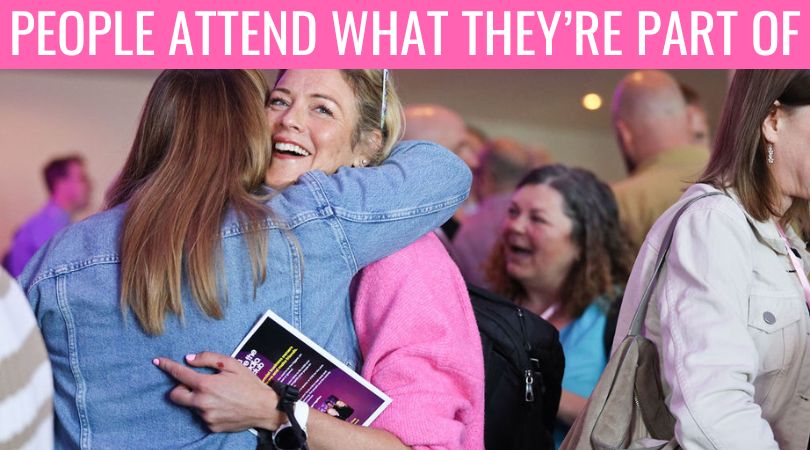
People don’t attend events because of what’s on. They attend because of what they’re part of.
It’s easy to assume that when budgets tighten, events suffer because people are cutting back. That’s not quite true. People don’t stop showing up, they just become more selective about where they invest their time, energy and attention.
What they’re really deciding is this: Do I feel part of this, or not? People attend events in tough times because they want reassurance that they’re not alone.
Jeremy Freeman recently shared that people are committing later to events. That feels right as it also raises a more important question. What makes someone commit in the first place?
Most events try to earn attention as they focus on speakers, schedules and selling tickets. We need to feel like we want to go.
I have learned that commitment doesn’t come from what’s happening on the day. It comes from whether people already feel connected before they even arrive.
There is a shift that most events are up against.
For a long time, value came from what you could produce. The speakers you booked, the agenda you created and the content delivered. That used to be enough, but it isn’t anymore.
What matters is creating something people trust and want to be part of. Something that brings people together in a way that feels natural, not forced.
When everything else feels uncertain, people don’t invest in more content. They invest in spaces where they feel grounded, recognised and part of something bigger than themselves.
That’s the role an event plays now. It’s proof you can bring the right people together.
Most events aren’t bad. People put a lot of time and effort into occasions that are well organised and provide value to others.
What happens is that longevity stalls and they fade because they exist in isolation. They’re treated as moments, rather than part of something ongoing.
A one-off event is a transaction, a connected event is a relationship. Events survive downturns when they behave like communities, not products.
I know that If Creator Day existed on its own, once a year, with no connection to anything else, it wouldn’t progress. It would plateau, and eventually it would fizzle out. The only reason it works is that it’s one piece of something bigger.
I don’t want people to arrive cold, I want them to arrive knowing that they already feel connected, before the main event starts.
I asked the You Are The Media community why they attend events, the answers didn’t point to speakers or agendas. I want to share so it’s not just my perspective.
1) People Can See You Care
Care is the differentiator people feel, even if they can’t always explain it.
I want people to know that I put in the effort and their involvement matters. For instance, Creator Day isn’t about turning up for one day, for the past nine months, I have sent an email every fortnight that is specific to the build-up.
It shows up in the effort, build-up and small details. This is why we have the Creator Day WhatsApp Group. The whole focus is being accessible to each other and if I can facilitate that, it’s how I want people to know they feel included before they arrive. It’s all intentional.
Christophe Stourton summed it up, “Why go back to an event, time after time? Because last time somebody cared about every aspect of your experience before, during and after the event.”
That’s what people come back for, it’s not about FOMO or promises, but the feeling that someone has thought about them.
Good logistics don’t build loyalty, care is what people remember.
2) People Feel Connected
This is where many events fall short. This is where attention is built around a stage, where it’s speaker to the audience.
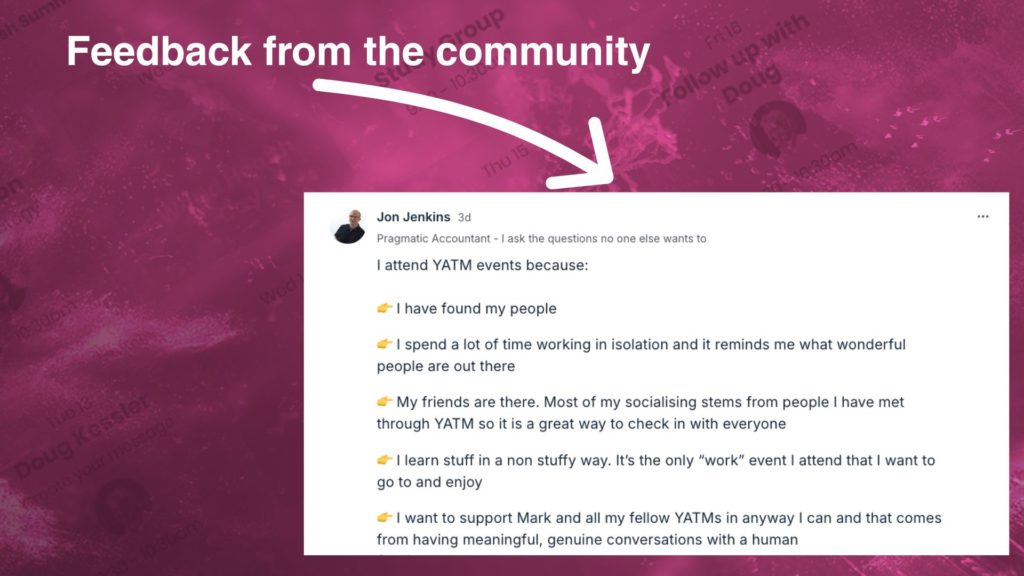
The strongest events aren’t built that way, they’re built when the people in the room become the experience itself. Jon Jenkins put it simply, “I have found my people, as most of my socialising stems from people I have met through YATM.”
People don’t attend just to learn, they attend because they know who they’ll be in the room with. It’s this familiarity that reduces friction and helps to build confidence.
Over the years, I have noticed people are not passive attendees anymore. I am seeing that everything feels stronger when people can contribute and participate. For instance, at this year’s Creator Day we’re going to decide on the day what to call the week of events that surround Creator Day in May 2027. We can all become part of what makes it work.
When the audience becomes the experience, the event becomes inherently valuable.
3) People Feel Connected To Something Bigger
People don’t just want a good event, they want to feel part of something that exists beyond it.
That’s why Creator Day works. Everything that surrounds it helps to contribute. Such as the weekly newsletter, YATM Club, the Lunch Clubs and the people others already know. Nothing is a one-off experience, what we’ve made with Creator Day is a gathering point for people (plus the benefit of being a seaside town).
If there’s no wider space, there’s nowhere for the good feeling and momentum to go after the event ends.
Without that, there’s no reason to come back. This is why the real leverage isn’t the speakers you have, it’s whether you’ve already built the room.
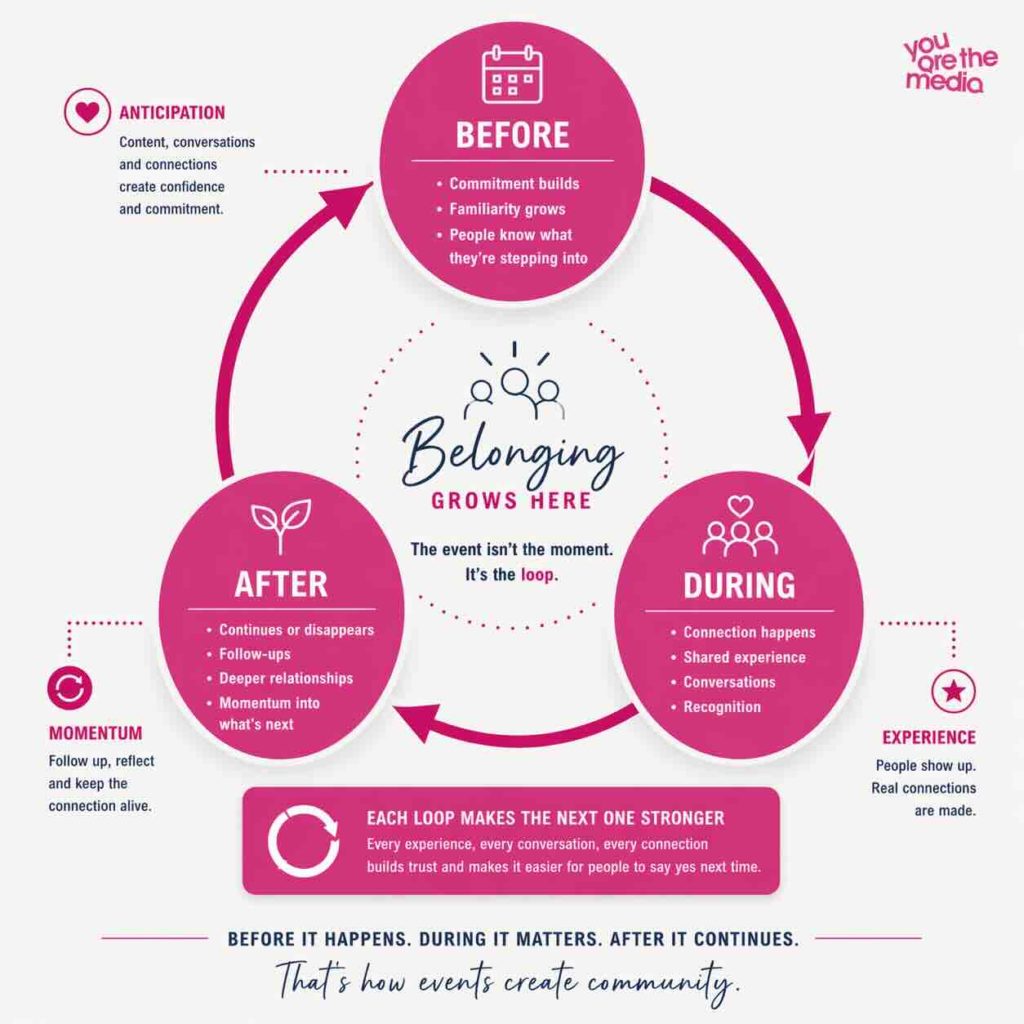
An event is part of a loop.
Before
This is where commitment is built.
Familiarity grows with people.
People know what they’re stepping into.
During
This is where connection happens.
Shared experience.
Conversations.
Recognition.
After
This is where it either continues or disappears.
Follow-ups.
Deeper relationships.
Momentum into what’s next and how people can join in.
Most events only designed for the middle, it you can build a system that is designed for all three, you can ride the wave of uncertainty.
This takes time. You can’t shortcut care. You can’t manufacture a connection on the day. You can’t build loyalty from a single experience.
You’re not in control of what happens between people, but you are responsible for making it possible.
If people leave thinking, “these are my people,” they’ll return. This means that when they return, it’s not because of what’s on, it’s because of what they’re part of.
In a tough economy, attention is fragile, but belonging is resilient. People will always find their way back to where they feel they belong.
A brand new programme from Mark Masters for businesses wanting to make that next growth step.
Find out moreShape more together