Let’s learn and create together!
Book your place
Please enter email and password to continue

You didn’t walk into a room thinking about status. You walked into a room looking for what might happen and hoping your friends would be inside.
Somewhere along the way, we learned a different rule.
Opening up and having fun is hard because it risks status.
That’s why letting your guard down can feel a bigger risk than giving a polished opinion. In adult life, being wrong feels costly and looking silly can stick with you. What happens is that we manage ourselves and hold back.
Bringing fun into your work isn’t a haphazard approach and it’s not as though you’re treating things lightly. It’s giving a nod to something many of us have forgotten.
I probably have more conversations with people about how busy they are than I do about how much fun they had at the weekend. Maybe you do too?
Busy has become a socially acceptable way to prove worth and it says, “I’m needed.” Fun, can sound self-indulgent and unserious.
We default to what feels safe as we know what professional needs to look like, so it shows that you have got it together.
What I have noticed is what this does to rooms. The more people try to sound credible, the less human the atmosphere becomes. The room might be full, but it’s not warm.
A lot of the work from YATM is about letting go. You give people permission to arrive as themselves.
Some people may see it as silly. But being silly is incredibly hard.
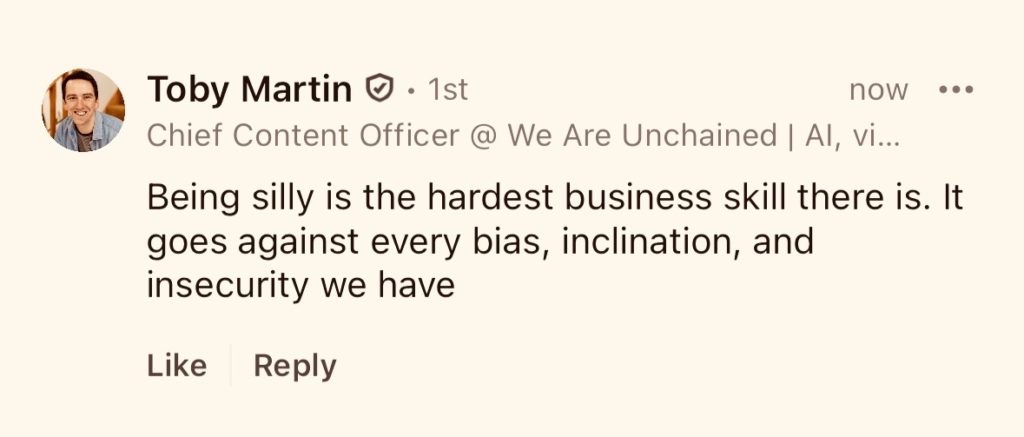
And this line from Toby Martin is so important, “Being silly is the hardest business skill there is. It goes against every bias, inclination, and insecurity we have.”
If you let your guard down first, someone else will follow.
As kids, we asked because we wanted to understand. As adults, we give opinions because we want to look like we understand.
As adults, we don’t just gain knowledge, we learn the cost of looking like we don’t know and that can hurt. We’ve now added a turbo booster to our work, so we can ramp up our level of knowledge in seconds. We can ask AI what to say and how to say it, so we borrow certainty.
On one level, it’s useful. On another, it quietly pulls us further away from curiosity and figuring things out for ourselves. If there’s always a ready-made answer, the urge to explore gets replaced by the urge to present.
The risk is that we become “correct” but not willing to play. I’ve always liked this from Nike founder Phil Knight, “My life was out of balance, sure, but I didn’t care. In fact, I wanted even more imbalance… If my life was to be all work and no play, I wanted my work to be play.”
There’s something defiant in that. Not ‘play’ as a distraction but play as the driver that keeps work from becoming a dead weight.
A Quick Metaphor That Holds This Together (The Sea In February
The sea in February presents two sides.
The adult voice says something different from the child voice.
The child side might see it as fun, freedom, and being with people. The adult side might see it as dangerous, too cold, inconvenient, irresponsible, or just ridiculous for the start of the year.
Same sea. Same reality. Different lens.
The lens does matters, because it shapes what we allow ourselves to do.
The adult lens constantly asks, ‘What’s the point?’ The child lens asks, ‘What happens if I try?’
A childlike approach doesn’t mean being reckless. It means being open.
When Judgement Enters The Chat
Fear of judgement is a great accompaniment to work. It keeps you safe, but it also keeps you smaller.
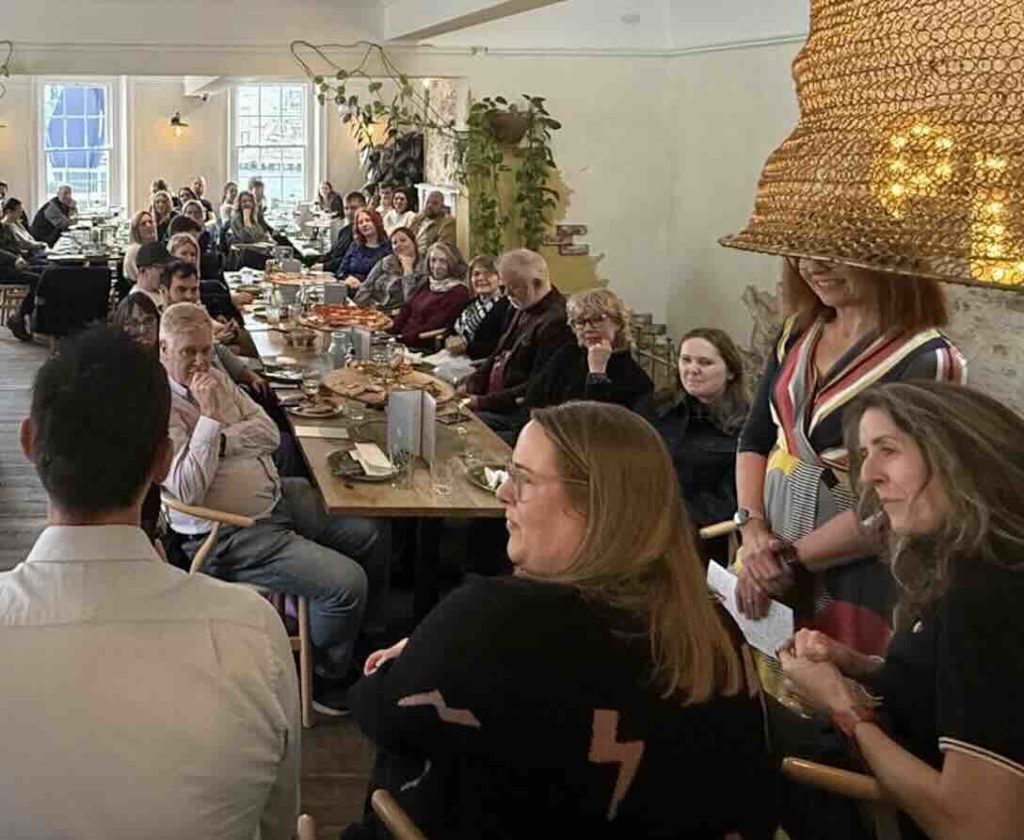
I saw this in earlier versions of our Lunch Club events. They were structured around a topic and a main speaker sharing their knowledge, from writing to the subject of SEO. People attended in the hope to leave feeling wiser.
That format works, but I realised I was delivering what everyone else was doing.
When the focus is predominantly ‘listen to someone tell you what to do,’ it takes away from playing together. It keeps the hierarchy in place and the audience as audience.
By always leaning into answers, our access to answers has increased, so has the fear of looking wrong. So we double down on performance.
What I have learned is how to find a style of gathering, where the childlike element is in place, such as being ok to ask, not having one person to look at, and letting lots of people share.
At Lunch Club, we’re known for trying to break world records and doing challenges. That’s not there for novelty (but it does make good social posts!). It’s there to lower the guard and get people in the moment together.
It is intended to remove the pressure to be impressive and replaces it with permission to join in.
Seriousness should never be the entry fee, the entry fee should be showing up as yourself.
We tried to break a World Record for the most high fives, in 10 seconds, touching your nose, on one leg at Lunch Club last week…
Most of YATM has been done by trying to figuring it out. I’m comfortable with putting my hand up today.
That’s different from, “Here’s what people should do.”
The figuring it out approach has built everything, the newsletter, the events, the Club, the experiments that worked and the ones that didn’t.
Right now, what I’m figuring out is how you turn a town into the central place for a main event, not just the venue that people head to.
This is where I see Creator Day progressing.
I live in a coastal town, Poole. So why can’t the town become part of the experience? When people arrive, everything is waiting for them, not just the schedule, but the feeling that the place itself is in on it.
The recognised way for conference-style events is either:
– everything in one building, or
– satellite events nearby.
But what if it was more like this:
– you go for a coffee and a code gets you a discount
– there are places to eat where the owners are ready for you
– you bump into people because the town has been shaped around the occasion
That’s my childlike approach to building something, not because it’s naive, it’s “what happens if we try this?” Figuring it out with other people shouldn’t be taken away from us.
That’s how you make something with longevity, you keep experimenting until the shape becomes obvious and you do it with people who make it feel safe to try.
A guard down is what happens when judgement stops being in charge.
It’s hard when you think you have to deliver a version of yourself that is always right. That version is exhausting and constantly checking the room for approval.
When you bring an inquisitive approach to your work, you open up a version of you that can take risks again. You let the inner child re-enter the room, where it’s about curiosity, trying, making friends and constantly asking other people.
The places that work are the ones where you’re encouraged to bring more of you to the table.
When you’re with the right people, judgement doesn’t happen and that’s the most grown-up thing you can build from.
A brand new programme from Mark Masters for businesses wanting to make that next growth step.
Find out moreWhere non-conformist business owners come to work, learn and make friends. Click here