Let’s learn and create together!
Book your place
Please enter email and password to continue
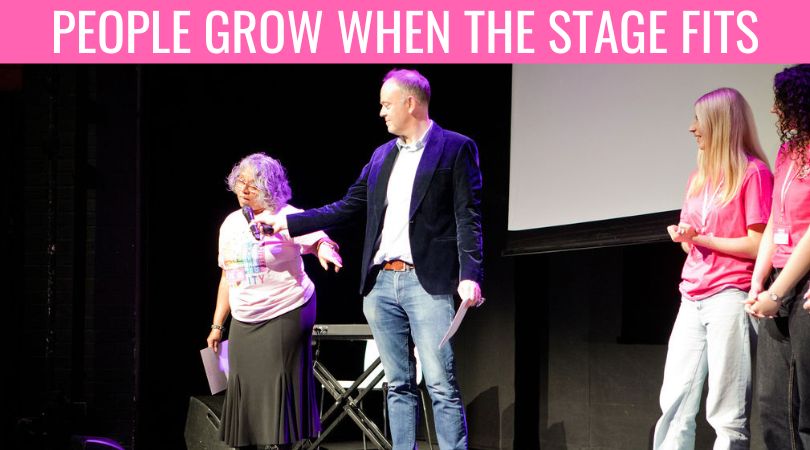
A focus for many communities is around connection and bringing people together. It matters so much, but connection alone isn’t always enough.
You can be connected and still stay quiet, or not know how to take your place inside it. The hard work is not just gathering people, it’s creating conditions where people feel safe enough to step forward.
That is where I am starting to see YATM differently. I am writing this after just delivering Creator Day ’26.
It is not just a newsletter, a membership, live events or a day in a theatre. It has gradually become a series of different-sized stages for people.
– Some are small enough for someone to try something for the first time.
– Some are supportive enough for someone to stretch a little further.
– Some are big enough for someone to realise they can carry a room.
Each one matters. It’s not because everyone is trying to become a speaker or public-facing version of themselves. The point is that people grow when they are given the right-sized chance to be seen.
In the beginning, YATM was my own place to practise.
The Thursday newsletter helped me find my voice. The early events helped me learn how to host and how to give people a reason to come back.
What started to happen is that the space I had built to help me practise started to become a space where other people could step up and be seen too.
That is what I can see more clearly now. YATM has become a shared stage, but not in one fixed size. It gives people different-sized places to try, contribute, be recognised and grow.
Let me share what I mean by the different stages.
The small stage is where someone begins.
It might be the person who is the newsletter takeover. This is the person who starts every Thursday, with the ‘hello and recommendation.’ It could also be someone who steps up and shares a win at Lunch Club. It might be asking a question in one of our sessions in our membership space, YATM Club.
These moments can look small, but for the person doing it, they often aren’t.
I have seen over the years that when someone puts a part of themselves forward, they discover there was a space for it.
These smaller stages give people a way to try and contribute. It feels good to be seen and noted for our efforts.
This is why smaller stages matter far more than they appear to. A newsletter takeover is not just content. A first question in a room is not just engagement. A shared win is not just a nice moment before the main session begins. They all represent identity rehearsals.
When you make the environment feel safe enough, people keep going.
The medium stage is where someone starts to take up a bit more space.
This is the person who hosts a Lunch Club or joins a panel. It could be a person who steps up to the front at Failed Nights, the evening before Creator Day.
The medium stage is about helping shape the experience for someone else.
If the small stage says, “I have something worth saying.” The medium stage says, “People value what I bring.”
Many people don’t need to be pushed into a bigger spotlight. They need someone to notice what they are already becoming where they are not on the edge of a room, they are part of it all and needed.
This is one of the most important things a healthy community can do. It doesn’t just give people a place to belong, but a place to contribute.
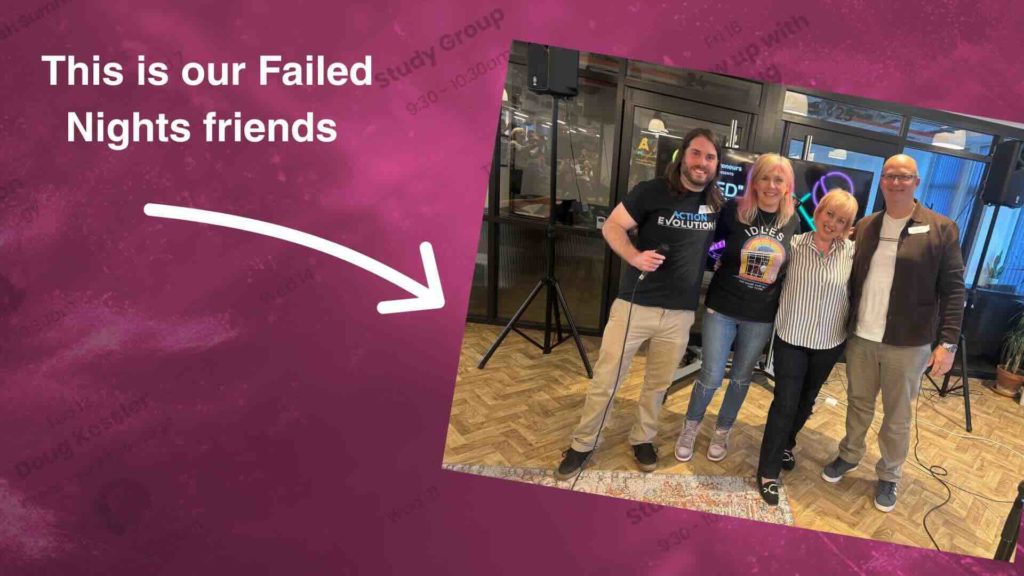
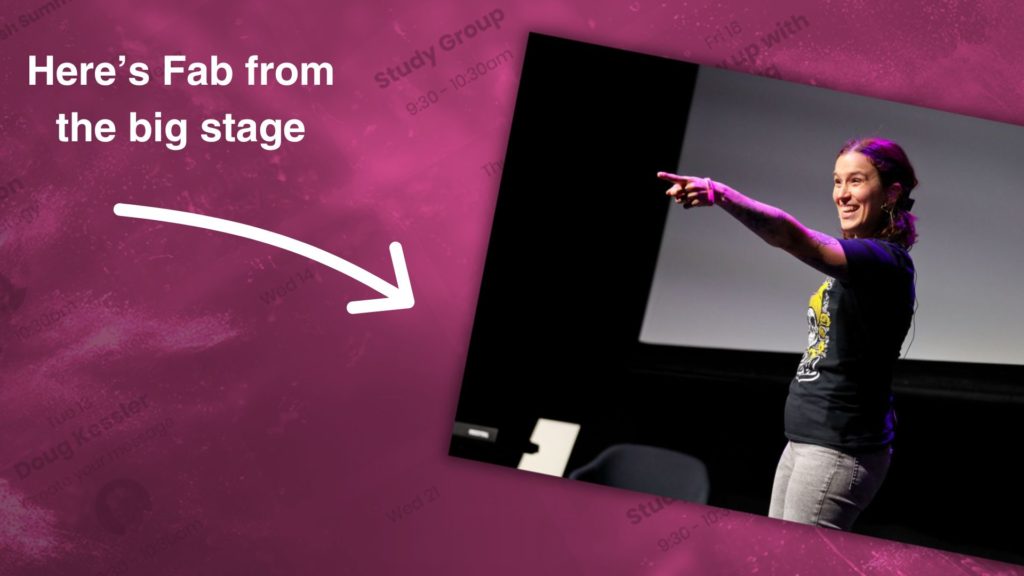
Then there is the big stage. This is the one everyone sees.
At Creator Day, it is the actual stage, in a theatre. The moment someone stands in front of the room and shares something they have lived, learned, built or believe.
By the time someone stands there, there has usually been a trail of smaller moments before it. It’s the work that just takes time.
That is why the big stage should never be treated as the prize that everyone is chasing. It isn’t the top of a hierarchy or the only measure of growth.
For some people, the big stage is right, but for others, the small stage is enough.
The important part is not the size of the stage, it is whether the stage fits the person someone is becoming. Each space fits the person who is within it. For instance, when visibility is forced, it becomes performance. When it becomes the right size, for the moment in time, it is about development. There is a world of difference between the two.
We often talk about confidence as though it is something people either have or don’t have. I’m not sure that’s always true.
People become braver when the cost of participation feels survivable.
They step forward when they feel they won’t be judged or when they know people are not waiting for them to fail.
People don’t become confident and then step forward. Often, they step forward in a safe enough space, and that experience helps them become more confident.
Safe visibility comes before confidence. This is what many professional spaces get wrong because they reward the people who already know how to perform. They give the platform to the most certain. Then everyone else quietly learns that being seen is only for people who have already arrived.
I know that most people haven’t arrived, but they are still working out what they think or how much of themselves they are allowed to bring into the room.
That is why stages matter. They are not stages as status, but of practice and recognition.
A healthy community is not just a place where people gather. It is a place where people get to become more visible and more of themselves.
That is my biggest learning of 2026, so far. People are rarely transformed by information alone (and information is everywhere today). They are transformed by experiences of participation that slightly change how they see themselves.
The first time they speak in front of other people, or they are recognised. It’s when someone thinks, “Maybe there is room for me here.”
That is where people begin to see themselves differently. It could be quiet at first, then in front of the whole room.
After Creator Day, I can see this more clearly, hence why I wanted to write this down.
The work is not building a bigger stage for yourself, it’s to build stages that other people can grow into.
Some will be small. Some will be medium. Some will be big enough to hold a whole room. They all matter.
We all need a place to begin and practice. Then people need the encouragement to progress and realise they can carry more than they thought.
That might be one of the most important things a community can provide. It’s not a spotlight, but a way towards it, that feels right.
A brand new programme from Mark Masters for businesses wanting to make that next growth step.
Find out moreShape more together