Let’s learn and create together!
Book your place
Please enter email and password to continue
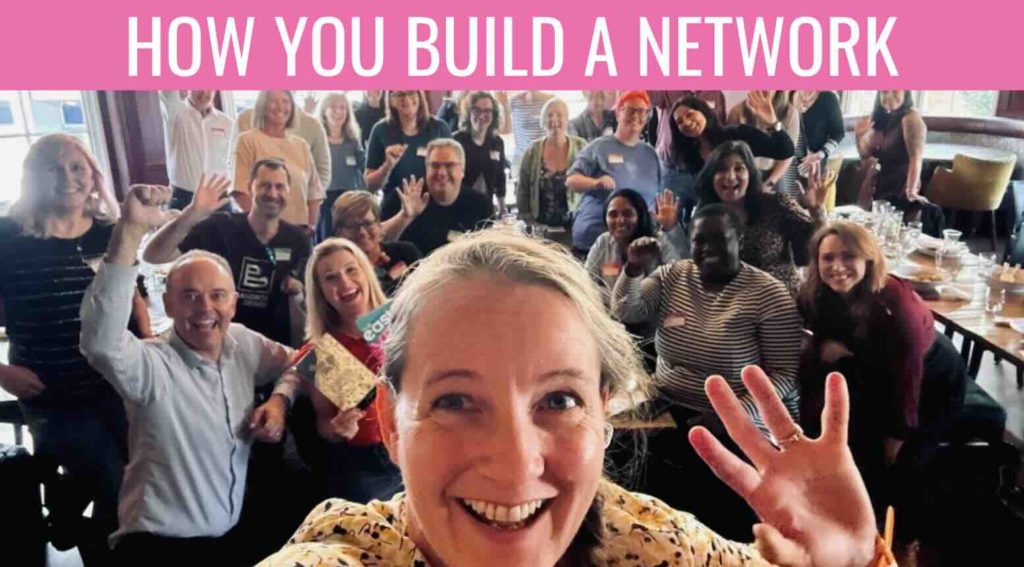
Over the past few weeks, YATM Lunch Clubs have taken us to Poole, London, Bristol and Manchester. Different locations, different venues and different people. I’m noticing that when you allow people to tell their stories, where it isn’t all on you, you can build a network.
Every event has seen people share something from their own perspective. Their own interpretation of an event that everyone steps into.
We normally think about networking from our own position, such as who could be useful to know or who I should introduce myself to.
When you build a network, it’s about what can I create that helps other people find each other.
You might still be the reason people initially gather, but the value can’t always depend on you being present in every conversation. This is one of my main learnings from 2026. Your success can eventually be demonstrated by your decreasing importance to every interaction.
At the beginning, this feels counterintuitive. When you start something, you have to do nearly everything. You invite people, you create the content and explain what everything means. Without that work, nothing moves and your efforts become obsolete.
But if years later every relationship still has to come through you, perhaps you’ve created an audience rather than a network.
A network starts becoming something different when people meet, help, recommend and invite one another without requiring you as the intermediary.
People need somewhere recognisable that everything connects back to. It could be your website or your newsletter.
For me, that place is You Are The Media.
There is the newsletter, Lunch Club, Creator Day, YATM Club and all the smaller things that happen around them. They are different experiences, but they connect to the same wider place.
I think of this as the container. It gives people an understanding of what they are stepping into.
Without it, you can have lots of events, content, conversations and introductions, but they can remain disconnected pieces of activity. It’s how you connect everything that matters. A mistake I made when I started was not giving people a place they could refer to, it doesn’t feel good when you have to cancel events through lack of interest.
A container doesn’t need to be complicated. It could be a newsletter, a breakfast event, a podcast, an online group or a project that people regularly contribute to.
What matters is that people can recognise it and return to it. Participation becomes more powerful when people understand what they are part of.
The emphasis in YATM is on a collective approach. There isn’t a voice in isolation, we all have a role to play. When people lift each other and they know other people are on the same side, what it does is help to create a sense of attachment and belonging.
The paradox is that you need a strong centre without always needing to be the centre of attention.
I’ve been noticing this at Lunch Club. People aren’t attending just to receive something.
Every location has a host and panellists, people are encouraged to chat and you create this feeling that can be replicated in different places. Even the Inter-City Challenge gives everyone something silly to rally around. The reason we do this is for people to know they can be themselves as soon as they step in.
The experience belongs partly to the people in the room. When information has become incredibly easy to access and knowledge is free, you can’t download participation.
I don’t want people on the sidelines, I want them stepping in and feeling part of the whole occasion.
When people feel part of something, they leave with something of their own to talk about.
People are encouraged to interpret in their own way and say, ‘I’m part of this.’
I can step up and make all the claims that it’s a great initiative to be a part of, but that can start becoming self-promotional if everything was directed from one side.
When somebody else tells the story, the ripple effect starts to happen.
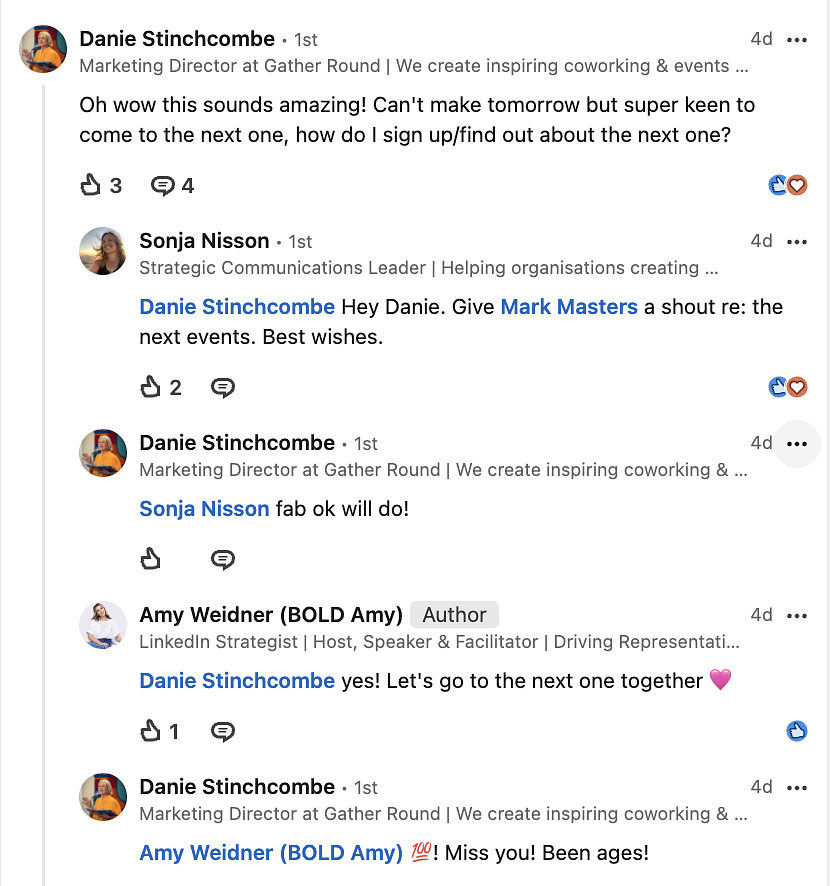
There are people around the country who have stepped up to share that they are part of the Lunch Clubs.
Have a look at these examples, to see what I mean.
It’s the experience from someone else that becomes evidence. The organisation makes claims, people provide proof. The aim isn’t to encourage people to say nice things about YATM so YATM gets more reach.
It’s about someone feeling ok to say, ‘I’m IN.’ That matters to the person sharing too. Their connections see where they were, what interested them and who they spent time with.
The story belongs to them and is told through their own goodwill.
That’s why I don’t think you should try to control how people interpret an experience. Someone might post about the main discussion, or just how good it felt to go out and make new work friends.
All of it counts. I am learning that you give people a framework, but you don’t give them the script.
Now look at all of this from outside the room. If all I did was post, I’d be saying ‘come to my event.’
We all need a place to start, but when you see several different people talking about their experience, the signal changes.
Slowly, the unfamiliar becomes familiar and you start to think, ‘There are people like me there.’
This is where participants themselves become part of the invitation. My marketing explains what Lunch Club is, but it’s the experiences of people that demonstrate what it feels like.
Every time somebody tells their version of the story, another doorway opens for somebody standing outside.
I am seeing the events now becoming on the radar for others who were unfamiliar and perhaps the next event feels like a good time for them to step in.
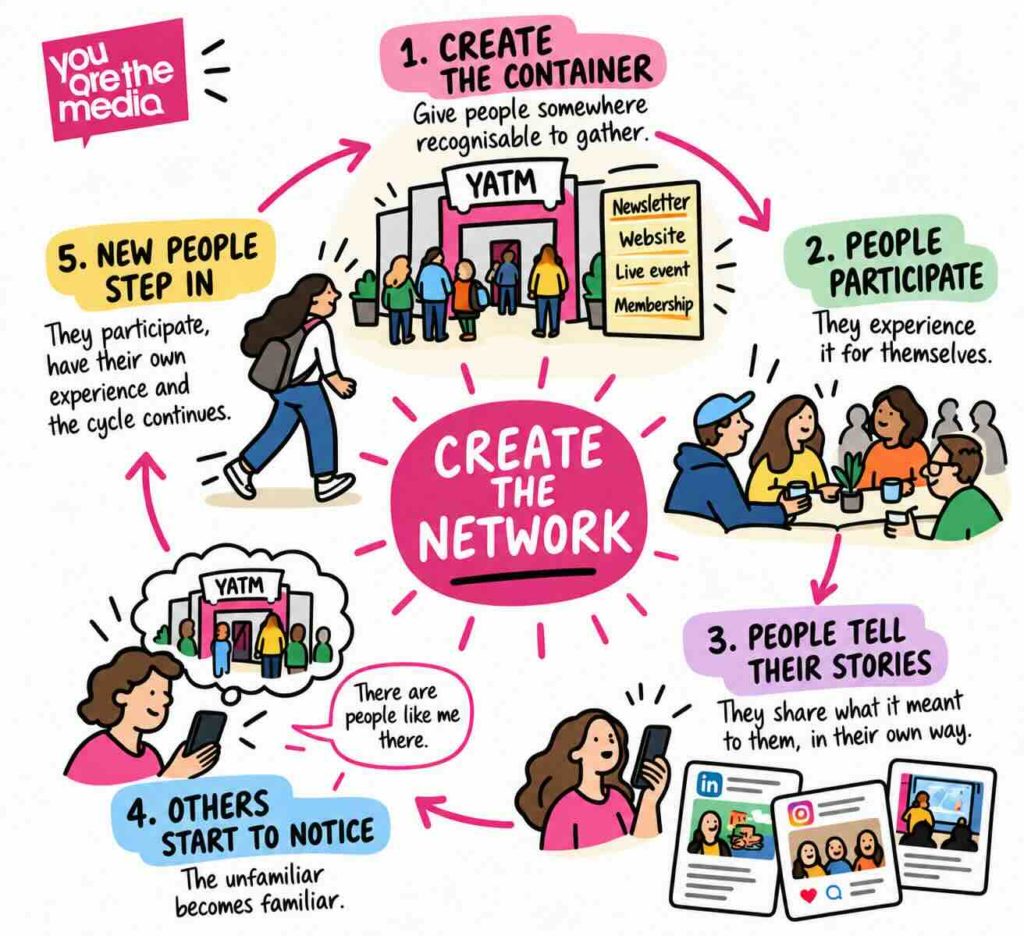
There is a loop that is starting to tie it all together:
Place → participation → evidence → recognition → participation.
– You create somewhere recognisable.
– People take part.
– Participation creates experiences.
– Those experiences travel into other people’s networks.
– Someone else sees that evidence enough times for the place to become recognisable.
– Eventually they join in too.
– Then they create another experience.
– The network grows
Networks take time.
YATM started in 2013. Being able to gather people in different parts of the country today isn’t the result of announcing a Lunch Club and putting tickets online. There are years underneath it, including ideas that worked and plenty that didn’t.
One gathering creates an experience. Repeated experiences give people history together.
The network is not longer lots of people connected to me. It becomes people connected to each other through something I helped create.
You start the network by creating the centre. You know it’s working when you’re no longer the centre of everything.
A brand new programme from Mark Masters for businesses wanting to make that next growth step.
Find out moreShape more together