Let’s learn and create together!
Book your place
Please enter email and password to continue
Not everything valuable happens immediately and not everything that matters can be measured while it’s happening.
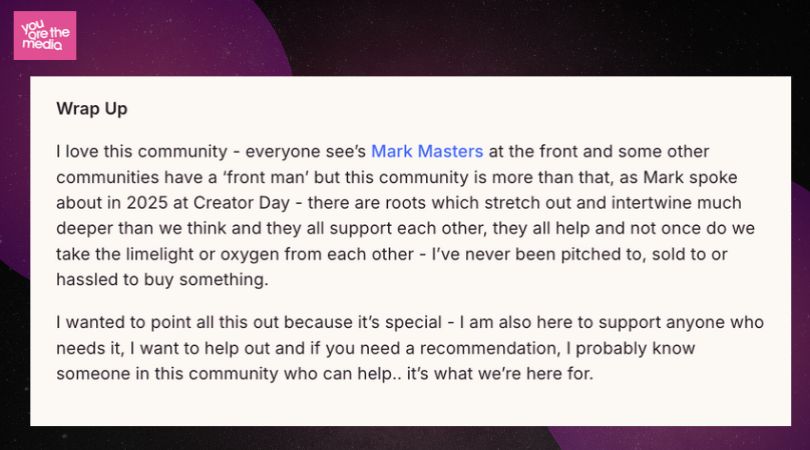
This article starts with a post from Matt King (in YATM Club). He started a new job at Euroflo in June, as managing director. Many people know Matt as the person who starts Creator Day with an opening film.
Last week, Matt shared how much the relationships he’d built through YATM have helped him in his new role.
When he needed help with the company’s IT infrastructure, he turned to Liam Toms and the Grapevine team.
When the company needed a new website, he approached Stewart Perrett at Giraffe Design.
When another company within the wider group of businesses needed a finance director, he recommended Jon Jenkins, someone he’d already worked with and trusted.
When Matt needed legal help, Laura Trapnell from Trethowans stepped in. They even signed and stamped a document in a car park after a Friday morning sea swim.
There were other introductions, recommendations and people who had helped him along the way.
This isn’t about the number of people Matt had turned to. It was something he kept repeating throughout his post.
Nobody had pitched to him.
These were people Matt had come to know through everyday conversations and part of the YATM community.
When Matt needed help, he already knew who he could trust. It had been building over time.
When we’re encouraging people to commit to our work, we naturally want them to understand what they’re getting.
If we’re organising an event, we share the speakers, the timetable and what happens during the day. If we’re selling training, we explain the sessions, what people will learn and the resources they’ll receive. If we’re inviting someone to join a membership, we describe the activities, the support and the opportunities to participate.
We all need to do this. People deserve to understand what they’re committing their time and money to.
We sometimes become so focused on explaining what’s included that we overlook what people might take forward. Someone might attend an event because they want to hear a particular speaker, a year later, they’re still talking to the speaker, and a relationship is in place.
A business owner might sign up for training because they want to become a better writer. Months later, they have the confidence to express their own opinions.
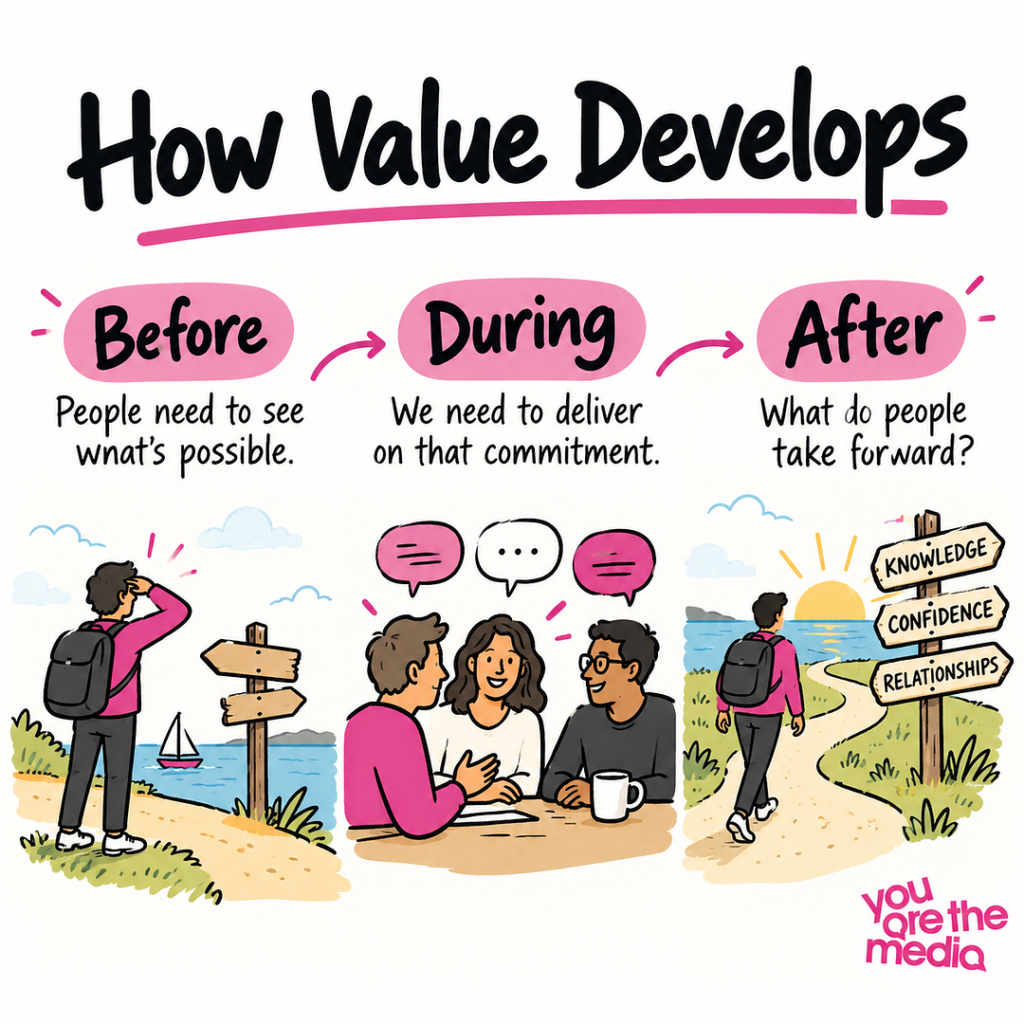
Being in the middle and leading YATM, I can see how value develops in three stages.
Before: People need to see what’s possible. They want to understand what they can expect and why making a commitment will be worthwhile to them.
During: We need to deliver on that commitment. People experience the work, gain knowledge, participate and start making connections.
After: What do people take forward? What can they do differently? Who do they know? What continues to make a difference when we’re no longer directly involved?
We spend a lot of time concentrating on the first two stages. We work hard to attract people, explain our value and create experiences that deliver on our promises.
The third stage can tell us just as much about the difference we’re making. As Matt demonstrated, it might be knowing exactly who to turn to when a problem needs solving.
Whatever you deliver for people, we’re conditioned to look for evidence that something has worked, preferably as soon as possible.
When we invest time, money and energy into something, it’s reasonable to want to understand the return.
I certainly want to know whether the events and activities we create are worthwhile. I’m becoming more conscious that immediate returns only tell us part of the story.
From Matt’s experience, the people he’s turned to weren’t creating commercial opportunities during his first few months in a new job.
Yet every interaction over the years created another opportunity to become familiar, understand one another and develop trust.
Just because the value isn’t visible today doesn’t mean it isn’t being created.
I know that the pressure to demonstrate immediate results can sometimes work against us. If we enter every room looking for the next customer, every conversation becomes an opportunity to sell.
If we constantly ask what we’re getting back, we might stop giving people the space to get to know us without expecting anything in return.
We become so focused on what a relationship might eventually produce that we forget it already has value. Having people who support us, share their experiences and want to see each other succeed is worthwhile in itself.
I have seen that the most worthwhile work we create won’t show its full value within the timescale we’ve given it.
The long-term value of relationships can be difficult to recognise when we’re focused on what happens immediately.
What we can count today can become different in the future. For instance, engagement tells us that people are participating. It doesn’t always reveal whether something they’ve experienced will influence what they do six months later.
Sales tell us that someone has made a commitment, but they don’t tell us the full story of what that commitment eventually means to someone else.
Numbers are useful as we need them to make decisions and understand whether our businesses are working, but they are not the complete picture. Perhaps a better question, some time later, is what happened next.
Did someone put an idea into practice? Did they make a decision they had previously avoided? Did they develop a relationship that became important to them?
This isn’t about abandoning measurement, it’s about becoming more curious about what we’re measuring.
We can measure the activity while it’s happening and still look for evidence of its impact further down the line.
We all want prospective customers, members and participants to see the value of what we’re offering. We could become better at demonstrating what continues after we’ve delivered it.
We can’t promise everything that might happen afterwards. However, we can share real stories of what people have gone on to do.
Matt’s post wasn’t written as a testimonial or a request to promote anything. It was someone sharing how other people had helped him, and wanting to offer that same support in return.
I wouldn’t have discovered this by looking at attendance figures or membership activity. The real value was in the relationships that continued to make a difference long after they were formed.
It makes sense to become more interested in those stories.
It is worthwhile to spend time thinking about what remains when the experience is over. What do people get to keep? The best value stays with people.
A brand new programme from Mark Masters for businesses wanting to make that next growth step.
Find out moreShape more together