Let’s learn and create together!
Book your place
Please enter email and password to continue
It means that your role and your message, might need sharpening.
If you get it right, the few who do come can become the people that help bring others. This is about that shift, from feeling beaten because the numbers weren’t what you expected, to building something that people want to be part of.
It’s how you move from a handful to hundreds and to share my own experience and learning.
I have had to cancel events because not enough people were interested.
I shared my story here from a few years ago and had to figure out why. The main reason was people didn’t know who I was or what YATM stood for. That made it easier for people to not commit.
Even when we made the switch from the YATM Conference to Creator Day in 2022, around 70 people attended. The idea was new to so many people, it was easier to stay away.
I want to share from the outset that delivering an event is hard. It can leave your ego feeling bruised and can give you a lot of self doubt. No one wants to pour their heart and effort into something where you look around at an empty space.
On the flip side, this presents such an opportunity to amplify the experience, where this becomes your differentiator no one else can replicate.
Bringing people together, getting them to trust you helps to give you the momentum to build on and keep going. It does work, one person at a time. You just have to keep with it.
Here’s how to turn low turnout into progress.
Maybe you’re planning your first in-person event, or maybe you’ve already delivered and it didn’t get the response you hoped for. Either way, this is what has worked for me and the shifts that have been made.
For the record, everything here goes beyond just promotion, LinkedIn posts and paid ads.
When few people turn up, it often means they don’t yet understand the role your event plays in their world.
Your overall intention isn’t yet obvious. In my article “Why Doing An Event Is Hard” I wrote, “Being responsible for getting the right people together is one of the most rewarding things you can do, but it’s also one full of potential pitfalls.”
Ask yourself…
– Why are you doing this event?
– Is it to showcase your expertise?
– Is it to bring people together around your message?
– Do you want start a community that will last beyond this one day?
If it’s just a generic topic and your goal is to fill seats, that lack of clarity shows. People can sense when something has no deeper purpose.
Action step:
Write a one-sentence mission for the event. Example: “I help independent business owners find their voice by giving them a live room of peers they can show up for.” Keep that in front of you through planning and promotion.
Once you know your role, make sure your message connects with the right people. These are the ones who will show up now (not the broad “I need 50 people to attend”).
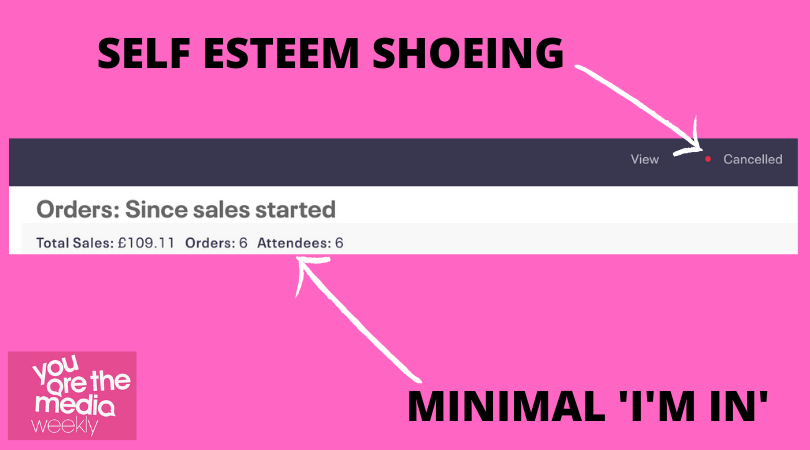
When YATM launched a new location in 2019, I had to cancel the first attempt (only six people had signed up). The next attempt was successful. The difference? I reframed what YATM stood for. It stopped being a side project of a company and became its own initiative, something independent, not a lead-generation exercise.
Key lessons:
– Show that the event is part of something bigger than a one-off.
– Make it clear who the event is for, why it matters, and what they’ll get.
– Give social proof (even if small) so no one feels alone in signing up.
Action step:
Draft a short headline and sub-line for your invite that suggests those three: the audience, the benefit, the proof. Such as “25 business owners will enter this room. We’ll walk out with the first step of your audience-growth plan.” Then embed that message everywhere.
This is the biggest leverage point that people miss. The handful who show up are the people you put every effort into. They are your early believers. Instead of seeing “only 10 people”, see “10 people who believe in me and who will help others join in”.
Key lessons:
– See attendees as allies, not transactions.
– Involve them. Mention them in posts. Highlight them in your newsletter.
– Make them feel part of what you’re building, their stories and reasons become part of yours.
When you shift from “few turned up” to “I have 10 founding friends”, you move from looking backwards to looking forwards.
Action step:
After the event, send a short personal note to each attendee. Thank them, ask one question, “Who else should be in this room next time?” and invite them to share one public takeaway. They become your first advocates.
Events work best when they’re not treated as one-offs but as anchors in an ongoing initiative. The goal isn’t one big turnout, it’s a community that keeps showing up.
From the YATM journey, we now connect each event and location so people see they’re part of something larger. This means that people know they are part of something bigger, that is connected with other people, like them in different towns and cities.
The basis is around improving logistics, refining the messaging, and layered community-touchpoints between events (newsletter, WhatsApp Groups, pre-event calls with the people involved).
Action step:
Sketch a timeline: Event → Follow-up → Next-event. That’s how a single event turns into a continuous journey.
Putting this together, here’s your checklist:
✅ Define your role. What you do for people.
✅ Clarify your message. Who it’s for, the benefit, and the proof.
✅ Identify your core attendees. The few who’ve shown up now.
✅ Engage them deeply. Make them feel valued and visible.
✅ Make your event part of a series. Plan the follow-through, not just the day.
✅ Gather feedback. Refine, communicate and repeat.
When few people turn up, it does hurt. I’ve cancelled events and I’ve wondered if my time is up.
The right people in the room, the way you build familiarity and trust with others, and your message being visible and clear are what turn a small turnout into a powerful foundation.
If you treat the 10, 20, or 50 attendees as the first seeds of something larger, those who will tell others, bring others, trust you as the organiser. You’ll shift from ‘only a handful showed’ to ‘these are our people.’
Making something you believe in that has a role to play for others does matter, not just for the people who showed up, but the people who will show up, and the community you’re building.
A brand new programme from Mark Masters for businesses wanting to make that next growth step.
Find out moreWhere non-conformist business owners come to work, learn and make friends. Click here